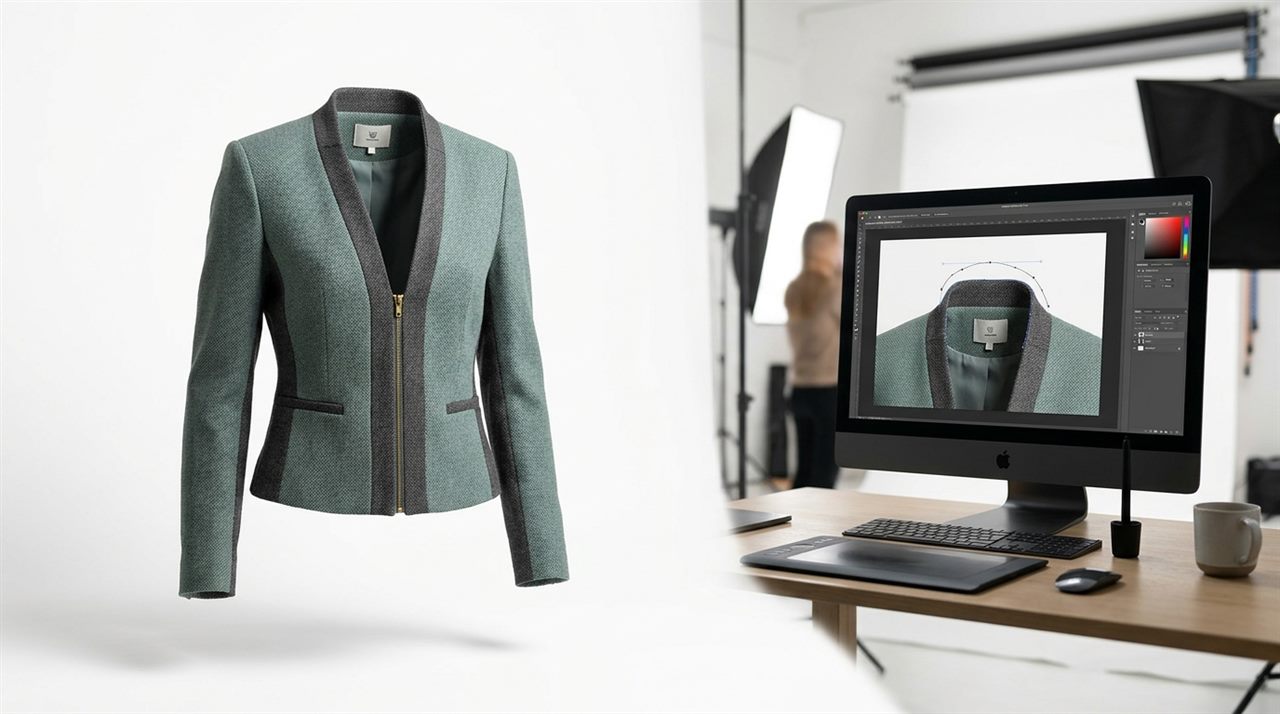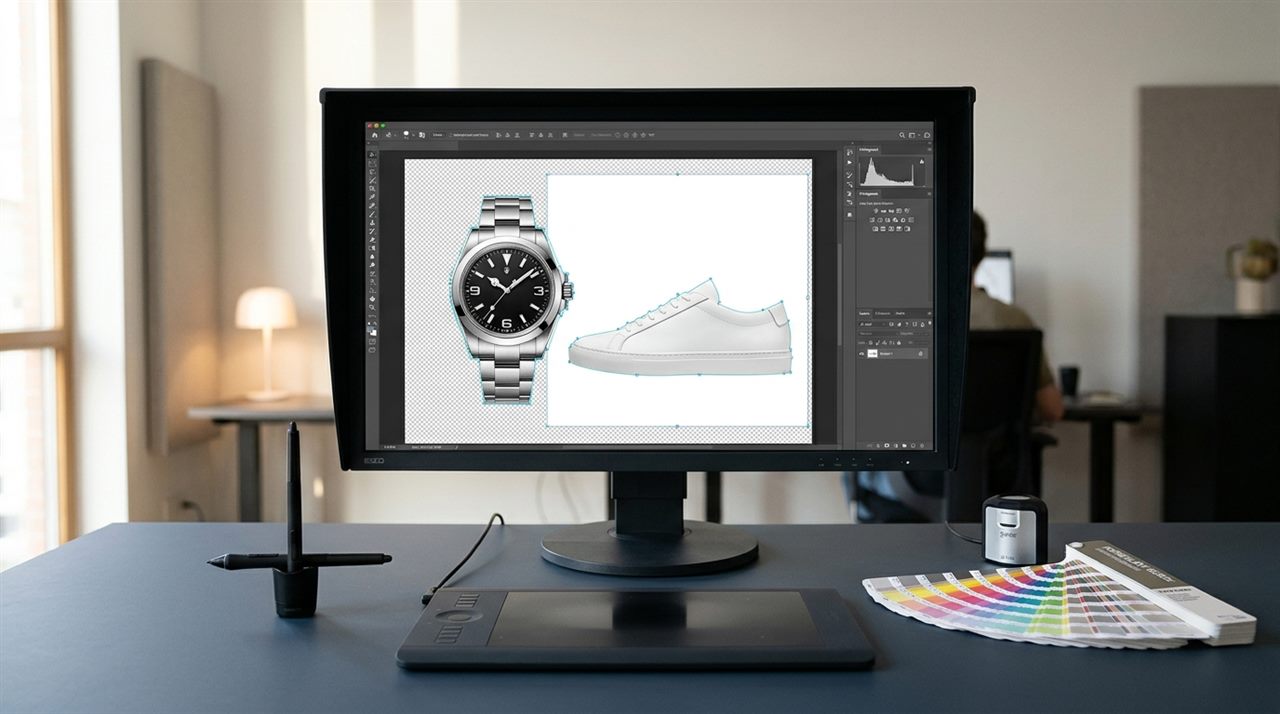
Every scaling e-commerce brand, multi-brand retailer, and commercial photography studio eventually confronts the exact same boardroom dilemma: should we hire a full-time in-house photo retoucher, rely on freelance marketplaces, or partner with a dedicated outsourced post-production studio? On a recruitment requisition, a single salaried retoucher looks neat and predictable—until finance factors in employer payroll taxes, health benefits, color-calibrated EIZO workstations, Adobe Creative Cloud seats, Art Director QA hours, and the unforgiving reality of retail seasonality where 60% of annual SKU volume lands inside a 10-week pre-launch window.
This 2026 enterprise benchmark manual dissects the true Total Cost of Ownership (TCO) across in-house teams, solo freelancers, automated AI tools, and dedicated outsourced retouching pods. Using live commercial production benchmarks from US, UK, and European e-commerce teams—and real volume tier data from Dinamico Studio's commercial pricing desk—we walk through itemized monthly P&L statements, regional salary comparisons, mathematical break-even crossover curves, worked CFO case studies at 500, 2,000, and 6,000 monthly SKUs, an AI-rework cost formula, and a 30-day zero-downtime migration SOP.
1. The Real Monthly P&L: In-House Retoucher vs. Outsourced Studio Pod
The single most common financial blind spot when evaluating an internal retouching hire is confusing gross base salary with loaded production cost. A mid-level commercial e-commerce retoucher in New York, Los Angeles, Austin, or Chicago commands $58,000 to $68,000 in 2026 base pay (and £38,000 to £46,000 in London). Yet base salary represents only 72% to 77% of what the business actually spends to keep that workstation productive.
Once you layer in statutory employer payroll taxes (FICA/Medicare or UK Employer NI), health insurance and pension contributions, Adobe Creative Cloud for Teams licensing, enterprise cloud NAS storage, hardware depreciation on a Mac Studio plus an EIZO ColorEdge calibrated monitor and Wacom Intuos Pro tablet, recruiting amortization, and five hours per month of Art Director QA management, the true cost lands at $6,450 per month ($77,400 per year)—before a single seasonal batch is retouched.
Look closely at the structural difference between these two balance sheets. An in-house employee is a fixed step-function commitment: whether your studio photographs 220 SKUs in February or 4,800 SKUs in October, you write the exact same $6,450 check in February (inflating your real cost to $29.31 per finished image) and still hit a hard throughput wall in October unless you recruit a second salaried seat or pay emergency weekend freelancer surcharges.
2. Regional Salary & Loaded TCO Benchmarks: US vs. UK vs. Western Europe (2026)
Because Dinamico Studio serves commercial e-commerce brands across North America, the United Kingdom, and mainland Europe, finance leaders frequently ask how the in-house equation shifts by geography. Even in regions with lower nominal salaries than New York or San Francisco, higher statutory employer social contributions (such as UK Employer National Insurance at 15%, German Sozialabgaben at ~21%, or French employer charges exceeding 35%) keep loaded in-house costs surprisingly elevated.
| Region / Studio Market | Mid-Level Base Salary | Employer Tax & Benefits | Gear, Adobe CC & QA Overhead | True Loaded Annual TCO | Cost / Image (at 1,200/mo) |
|---|---|---|---|---|---|
| United States (Tier-1 Metro) | $60,000 / yr | $10,800 (~18%) | $6,600 / yr | $77,400 / yr ($6,450/mo) | $5.38 / image |
| United Kingdom (London / SE) | £42,000 / yr | £7,560 (~18%) | £5,240 / yr | £54,800 / yr (~$69,500) | $4.83 / image |
| Germany / Netherlands / Nordics | €48,000 / yr | €10,560 (~22%) | €5,440 / yr | €64,000 / yr (~$69,800) | $4.85 / image |
| Outsourced Dedicated Studio Pod | $0 Fixed Payroll | $0 Employer Tax | $0 Hardware / CC | $10,800 / yr ($900/mo) | $0.75 / image |
Even if a brand shoots a perfectly flat 1,200 images every single month with zero seasonal dip, an internal US retoucher averages $5.38 per image and a UK/EU retoucher averages $4.83–$4.85 per image—more than 6.4× higher than a volume-tiered commercial studio pod handling the exact same hand-drawn clipping paths, natural floor shadows, and dust removal.
3. The Mathematical Break-Even Curve: At What Volume Does In-House Win?
To determine whether there is a high-volume threshold where in-house hiring overtakes outsourcing on pure unit economics, we modeled total monthly spend across 250 to 8,000 commercial e-commerce images per month. In-house capacity is constrained by physics: a skilled commercial retoucher working 160 productive hours per month (after accounting for PTO, holidays, file ingestion, renaming, and Slack revisions) averages 9 to 11 finished catalog images per hour—capping sustainable quality output at roughly 1,600 images per seat per month. Crossing 1,600 images requires hiring Seat #2 ($12,900/mo); crossing 3,200 images requires Seat #3 ($19,350/mo).
Monthly Spend vs. Image Volume (In-House Step Cost vs. Elastic Outsourcing)
In-house requires adding a full $6,450/mo salary block every ~1,600 images; outsourcing scales smoothly with volume discounts.
The mathematical takeaway is unmistakable: purely on repeatable e-commerce SKU production, an in-house retouching department in North America or Western Europe never achieves a lower cost per image than a specialized commercial studio pod—not at 250 images, not at 1,500 images, and not at 8,000 images. Instead of hiring internal retouchers to draw thousands of Pen Tool clipping paths, high-margin retail organizations reserve internal payroll for high-leverage creative direction (brand lookbooks, on-set lighting, campaign compositing) and outsource 100% of repeatable PDP catalog execution.
4. Three-Way Operational Scorecard: In-House vs. Freelancer Marketplaces vs. Dedicated Studio Pod
Many founders initially reject in-house hiring because of payroll cost, only to swing to the opposite extreme—hiring ad-hoc solo freelancers on Upwork or Fiverr. While freelancers appear cheap per hour, they introduce severe operational fragility once a brand scales past 200 images per month. Compare all three models across the eight operational variables that actually impact e-commerce revenue:
| Operational Dimension | In-House Retoucher | Freelance Marketplace (Upwork/Fiverr) | Dedicated Outsourced Studio Pod |
|---|---|---|---|
| Monthly Cost Structure | Fixed $6,450+/mo regardless of shoot volume | Variable, but unpredictable rush surcharges | Elastic volume tiers ($0.49–$2.50/img); $0 idle cost |
| Peak Q4 / Drop Surge Capacity | Hard ceiling (~1,600/mo); misses launch dates | Unreliable—freelancers juggle other clients | Instant 5× surge (1,000+ images overnight) |
| Turnaround SLA | 3–10 business days during catalog drops | Variable; frequent timezone delays | Guaranteed 12–24h (6h rush option) |
| Independent Quality Assurance | Self-checked (prone to screen-fatigue errors) | None—your internal team must inspect every file | Dedicated 3-Point Black / Gray / White QA Lead |
| Multi-Category Specialization | 1 generalist across apparel, jewelry & shoes | Must manage 3–4 separate contractors | Category specialists (Jewelry, Apparel, Color, Path) |
| PTO / Illness Continuity | Zero backup when employee is out | High ghosting risk during peak retail weeks | 24/7 redundant pod with zero single point of failure |
| IP & Unreleased SKU Security | Controlled on company hardware | High leak risk on personal unmanaged devices | Strict mutual NDA + 256-bit encrypted cloud transfers |
| Art Director Mgmt Overhead | 5–8 hrs/month (1:1s, HR, reviews, gear) | 8–12 hrs/month (briefing, chasing, re-edits) | <1 hr/month (locked Brand Spec Sheet) |
5. The AI vs. Manual Quality-Failure Cost Formula (Why "Free AI" Costs More)
In 2026, nearly every brand tests automated AI background removal and generative cleanup tools before talking to a commercial studio. Automated AI works nicely for internal slide decks or casual social drafts—but on revenue-generating Shopify, Amazon, and luxury wholesale PDPs, AI introduces a hidden tax we call Blended Rework Cost.
When you feed 1,000 real-world e-commerce images—white sneakers on white sweeps, sheer silk blouses, fine knitwear, metallic watch bracelets, or handbags with thin straps—into automated AI cutters, 22% to 35% fail commercial QA due to chewed edges, semi-transparent white halos, missing inner neck-joints, or unnatural plastic textures. When your internal e-commerce manager or photographer stops what they are doing to manually rescue 280 rejected AI files in Photoshop (averaging 6 minutes per fix at a $45/hr internal cost), look at what happens to the math:
AI Tool Subscription ($90) + 280 Manual Reject Fixes × 6 min × $45/hr ($1,260 internal staff time) = $1,350 Total Cost ($1.35/image) — plus 28 hours of lost internal creative focus and inconsistent edge quality.
Manual Outsourced Studio Pod (100% Hand-Drawn Pen Tool + 3-Point QA): 1,000 images × $0.55 = $550 Total Cost ($0.55/image) — with >98.8% first-pass approval and zero internal rework hours.
That is why enterprise retailers never use raw AI output on primary marketplace hero images—especially on Amazon, where a single RGB 252 gray edge halo or cropped lace triggers listing suppression under 2026 marketplace compliance rules.
6. Three Worked Financial Case Studies: 500 vs. 2,000 vs. 6,000 Monthly SKUs
To make this concrete for CFOs and Heads of E-Commerce building 2026 production budgets, here are three real-world brand scenarios modeled across a full 12-month retail calendar (including two quiet trough months and a 2.5× Q4 holiday peak):
Boutique & Emerging DTC
Annual Volume: 6,000 images (4 seasonal drops + monthly restocks).
Scaling Shopify & Amazon Brand
Annual Volume: 24,000 images (ghost mannequin, cutouts & color variants).
Enterprise Fashion & Agencies
Annual Volume: 72,000 images (multi-brand catalog + lookbooks).
7. Six Hidden P&L Drains Most Brands Forget to Put in the Spreadsheet
Even beyond direct payroll and hardware, six operational drains quietly compound inside in-house post-production teams—turning a "reasonable" headcount decision into a recurring margin leak:
Idle Trough Capacity
Apparel and footwear shoots cluster around seasonal drops. Paying full salary during 3–4 quiet months inflates annual per-SKU cost by 28%–40%.
Delayed Time-to-Live Revenue
If a 1,200-image drop sits in a solo retoucher's queue for 9 business days instead of launching overnight in 24 hours, you forfeit 8 days of peak full-price sales.
Single-Point-of-Failure PTO
When your lone in-house editor takes two weeks of vacation or calls in sick right before an Amazon Prime Day upload, catalog publishing halts completely.
Specialist Skill Gaps
A great apparel retoucher rarely excels at macro diamond focus stacking or complex hair & fur alpha masking. A studio pod assigns specialists per category.
Hardware & Calibration Drift
Mac Studio + EIZO ColorEdge + X-Rite spectrophotometer + RAID storage costs $6,500–$8,500 upfront per seat and refreshes every 3 years.
No Independent 3-Point QA
Self-checking your own paths after 6 hours of screen fatigue lets white-halo fringes and RGB 252 background errors slip straight onto Amazon Seller Central.
8. 2026 Per-Service Cost Benchmarks: In-House Effective Cost vs. Outsourced Studio Rate Card
Because commercial catalogs rarely consist of a single edit type, procurement and e-commerce managers need line-item clarity by service complexity. Below is the 2026 benchmark comparing what each edit type effectively costs when performed by a loaded US/UK in-house retoucher (at $40.31/hr loaded productive rate = $6,450 ÷ 160 hrs) versus a specialized outsourced production pod:
| Post-Production Service | Avg. In-House Time / Image | In-House Loaded Cost / Image | Outsourced Studio Pod Rate | Net Savings / Image |
|---|---|---|---|---|
| Hand-Drawn Clipping Path (Simple–Medium) | 4–6 minutes | $2.70 – $4.05 | $0.49 – $0.99 | 76% – 82% |
| RGB 255 Background Removal + Shadow | 5–7 minutes | $3.35 – $4.70 | $0.55 – $1.10 | 77% – 84% |
| 3D Ghost Mannequin & Neck-Joint | 10–14 minutes | $6.70 – $9.40 | $1.25 – $2.25 | 76% – 81% |
| Multi-SKU Color Change (Delta-E < 2.0) | 8–12 minutes | $5.35 – $8.05 | $0.99 – $1.95 | 76% – 81% |
| Complex Hair, Fur & Sheer Alpha Masking | 12–18 minutes | $8.05 – $12.10 | $1.50 – $3.25 | 73% – 81% |
| Luxury Jewelry & Watch Retouching | 20–35 minutes | $13.45 – $23.50 | $3.50 – $7.50 | 68% – 74% |
| High-End Editorial / Model Retouching | 18–30 minutes | $12.10 – $20.15 | $2.50 – $6.00 | 70% – 79% |
Notice that the savings percentage stays remarkably consistent (68% to 84%) across both entry-level cutouts and high-skill luxury jewelry retouching. That is because a specialized studio divides labor cleanly—junior path technicians handle pure vector outlines while senior colorists and jewelry specialists handle 16-bit reflection cleanup and frequency separation—rather than paying one Western generalist $40+/hr to do everything sequentially.
9. SLA & Vendor Governance: 7 Non-Negotiable Clauses Before You Sign
Outsourcing only delivers enterprise ROI when quality, confidentiality, and delivery predictability are contractually locked in. Before moving a single production drop to an external post-production partner, procurement and creative leadership should verify all seven governance standards:
- 1. Guaranteed Turnaround Tiers With Rush Overflow: Confirm written 24-hour standard, 12-hour overnight, and 6-hour urgent SLAs—and ask how many parallel retouchers are assigned to your pod during Black Friday or fashion-week peaks.
- 2. Free Unlimited Revision Window: Reputable studios stand behind their Brand Spec Sheet with free revisions within 7–14 days whenever a delivered file misses your crop, shadow, or color specification.
- 3. Non-Destructive Layered PSD Availability: Even if your storefront publishes compressed 8-bit sRGB JPEGs or WebPs, verify that your studio can deliver editable layered PSD/TIFF master files with intact vector clipping paths and adjustment layers for future campaign reuse.
- 4. Mutual NDA & Encrypted Cloud Transfers: Never email unencrypted Dropbox links of unreleased seasonal collections. Require 256-bit encrypted direct cloud uploads (supporting 2 GB RAW/TIFF/PSD files), strict no-portfolio-display clauses, and defined file retention/purge windows.
- 5. Independent 3-Point Visual QA Sign-Off: Confirm that the person who drew the clipping path is not the same person who approves the batch. Every export must be audited by a separate QA lead against 100% black, 50% neutral gray, and RGB 255 pure white.
- 6. Zero Unapproved Sub-Contracting: Low-cost brokers often auction your files to anonymous third-party freelancers overnight, destroying consistency and breaking NDA compliance. Insist on an in-house dedicated studio pod where every editor works inside the vendor's managed facility.
- 7. Transparent Volume Price-Locks Without Forced Retainers: Avoid rigid monthly minimums that penalize quiet retail months. The best commercial studios offer tiered volume discounts based on batch or monthly volume with zero idle-month penalties.
10. The 30-Day Zero-Downtime Migration SOP (How Top Brands Transition Cleanly)
Switching post-production from an overloaded internal team or unreliable freelancers to a dedicated studio pod does not require pausing your launch calendar. The top 5% of London and New York e-commerce operations follow a structured four-week transition:
- Week 1 — Audit True TCO & Build Your Permanent Brand Spec Sheet: Separate creative campaign work (keep in-house) from repeatable SKU execution. Lock one-page specs covering canvas aspect ratio (1:1 square or 4:5 portrait), margin percentage (8%–12%), RGB 255 pure white rules, natural contact shadow opacity, sRGB IEC61966-2.1 color profile, and SKU file-naming conventions.
- Week 2 — Run a Blind 3-SKU Stress-Test Pilot: Upload 2–3 of your most difficult unedited RAW files—for example, a white knit sweater for 3D ghost mannequin compositing, a reflective steel watch for macro jewelry retouching, and a sneaker with a Pantone swatch for Delta-E < 2.0 multi-SKU recoloring. Inspect paths at 300% zoom and benchmark real turnaround speed.
- Week 3 — Parallel Production Batch (200–500 SKUs): Route one live seasonal drop through the studio's encrypted upload portal at 5:00 PM and verify 9:00 AM next-day ZIP delivery. Confirm first-pass approval exceeds 98.5% and calibrate any subtle shadow or skin-tone preferences once so they are locked permanently into your pod's QA checklist.
- Week 4 — Full Overnight Handoff & Monthly KPI Cadence: Reassign internal creative staff to higher-ROI work (paid-social video, lifestyle lookbooks, CRO testing) while your outsourced pod handles 100% of repeatable catalog batches with predictable per-SKU pricing and elastic Q4 surge capacity.
11. Frequently Asked Questions on Photo Editing Outsourcing & ROI
How much does a full-time in-house photo retoucher really cost in 2026?
In the US, a mid-level commercial retoucher earning $60,000/yr base salary costs roughly $77,400/yr ($6,450/mo) fully loaded after employer payroll taxes, health benefits, Adobe Creative Cloud seats, color-calibrated EIZO/Mac Studio depreciation, and Art Director QA management time. In London/UK, a £42,000 base hire reaches ~£54,800/yr fully loaded.
At what monthly image volume does outsourcing beat hiring in-house?
Purely on catalog production cost (clipping paths, ghost mannequin, shadows, and color variants), outsourcing beats a Western in-house hire from 100 images/month all the way past 8,000 images/month because in-house requires adding another $6,450/mo salary block every ~1,600 images of monthly throughput.
Is AI background removal cheaper than outsourcing to a manual retouching studio?
Automated AI tools cost pennies per click, but on commercial apparel, jewelry, and white-on-white products they produce a 20%–35% reject rate (halo fringes, eaten lace, missing 3D neck-joints). Once an internal team member spends 6–10 minutes fixing AI rejects, the real blended cost exceeds manual Pen Tool outsourcing ($0.49–$0.75/image).
How does a dedicated outsourced studio compare to hiring freelancers on Upwork or Fiverr?
Solo freelancers create single-point-of-failure risk (illness, timezone drops, inconsistent color across batches) and lack independent QA. A dedicated commercial studio pod assigns a permanent Brand Spec Sheet, multi-editor surge capacity for 1,000+ image overnight drops, and an independent 3-point Black/Gray/White QA director.
How fast can an outsourced post-production pod match our existing brand aesthetic?
By submitting 2–3 RAW sample files alongside reference images from your live Shopify or Amazon store, a senior studio pod documents your exact crop ratio, margin percentage, shadow density, and sRGB/Delta-E tolerance in a permanent Brand Spec Sheet within 24 hours.
How are unreleased seasonal collections and intellectual property protected?
Enterprise studio partners operate under mutual NDAs, 256-bit encrypted cloud transfers (supporting RAW, PSD, and TIFF up to 2 GB per file), role-restricted workstation access, and strict no-portfolio-use clauses so unreleased collections never leak.
What is the ideal hybrid workflow for brands shooting 3,000+ SKUs per month?
Keep creative leadership in-house (1 Art Director / Senior Photographer who owns lighting, styling, and hero campaign direction) and route 100% of repetitive SKU production (clipping paths, ghost mannequin, dust cleanup, color variants) to an overnight outsourced pod with 12–24h turnaround.
Can we benchmark outsourced quality and exact per-SKU pricing before committing?
Yes. Always run a zero-risk pilot with 2–3 of your hardest SKUs (such as dark knitwear, reflective watches, or white-on-white footwear) to audit Pen Tool path precision, Delta-E color fidelity, and real turnaround speed before migrating full catalog batches.
Calculate Your Exact Per-SKU Studio Rate in 45 Minutes
Upload 2–3 sample product images (RAW, TIFF, PSD, or JPEG) for a free hand-retouched quality test and a custom volume pricing sheet tailored to your monthly catalog.