Amazon, Shopify & Etsy Product Image Requirements 2026: Complete Spec Sheet & Optimization Guide
Key Takeaways & Summary
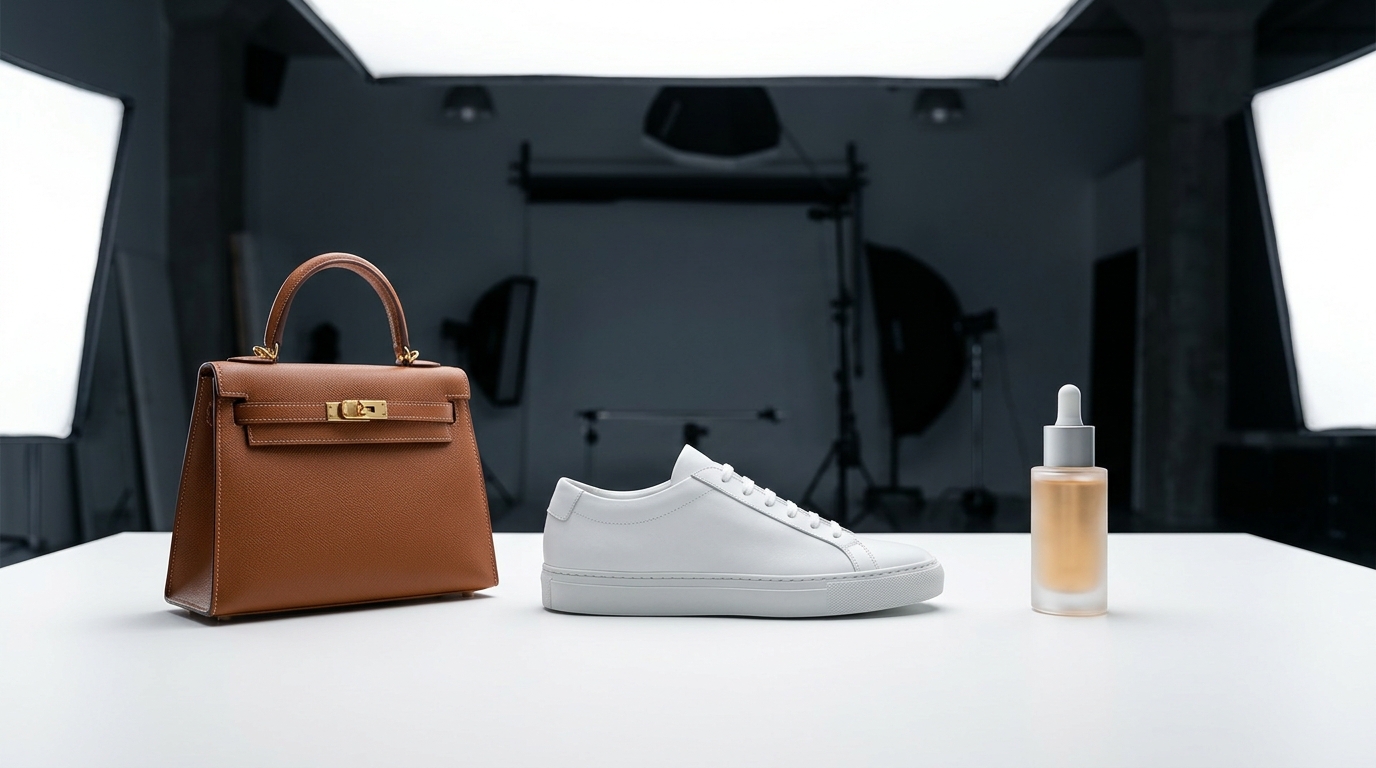
- One Master, Three Channels: Retouch one 3000×3000px 16-bit layered PSD with a manual Pen Tool path & separate contact shadow, then batch-export Amazon, Shopify, and Etsy specs cleanly.
- Exact RGB 255,255,255 White: Studio white paper reads RGB 242–248 and triggers Amazon search suppression; only manual clipping paths or alpha masks guarantee clean #FFFFFF edges.
- Mobile-First Aspect Ratios: Use 2000×2000px (1:1) for Amazon zoom, 2048×2560px (4:5) for high-converting Shopify fashion cards, and 2700×2025px (4:3) with a 1:1 center safe zone for Etsy.
- sRGB & File Weight Discipline: Always convert to 8-bit sRGB IEC61966-2.1 (never AdobeRGB/CMYK) and keep Shopify JPEGs under 400 KB to protect Core Web Vitals LCP.
In 2026, your product photographs do far more than illustrate what you sell—they directly determine whether your listing stays active on Amazon, converts mobile shoppers on Shopify, or wins algorithmic discovery on Etsy. Yet over 34% of catalog uploads still suffer from silent conversion leaks: off-white backgrounds that trigger Amazon suppression bots, oversized uncompressed PNGs that crush Shopify Largest Contentful Paint (LCP), or awkward aspect-ratio crops that chop off product edges in Etsy search grids.
This comprehensive 2026 technical spec sheet and optimization manual gives e-commerce founders, studio photographers, and marketplace managers one authoritative reference. You will find exact pixel dimensions, aspect ratios, background RGB values, file size ceilings, ICC color profile rules, visual performance benchmarks, and the 7-stage pre-upload quality assurance pipeline used by Dinamico Studio's commercial post-production team across thousands of daily SKUs.
1. The Master 2026 Product Image Spec Matrix (Amazon vs. Shopify vs. Etsy vs. Google)
Before diving into platform-specific edge cases, bookmark this side-by-side production specification table. Every value below reflects the optimal commercial production target—not just the bare minimum accepted by each upload form—so a single high-resolution master edit can be cleanly derived for every sales channel without reshooting.
| Technical Specification | Amazon (Main Image) | Shopify (Storefront OS 2.0) | Etsy (Listing & Search) | Google Shopping (Bonus) |
|---|---|---|---|---|
| Optimal Dimensions | 2000 × 2000 px (Min 1600 px for zoom) |
2048 × 2048 px (1:1) or 2048 × 2560 px (4:5) |
2700 × 2025 px (4:3) or 2000 × 2000 px (1:1) |
1500 × 1500 px (Min 800 px apparel) |
| Minimum Accepted | 500 px longest side (zoom disabled < 1000 px) |
800 × 800 px (for theme zoom) |
2000 px shortest side recommended |
250 × 250 px apparel; 100 × 100 px other |
| Aspect Ratio | 1:1 Square (strictly preferred for search) |
1:1 Square or 4:5 Vertical (fashion/mobile) |
4:3 Horizontal (1st photo) or 1:1 Square |
1:1 Square (standard Shopping ads) |
| Background Rule | Mandatory Pure White RGB 255, 255, 255 |
Brand-consistent Pure White, Soft Neutral, or Editorial | Warm Lifestyle or Clean Neutral (1st photo) | Pure White or Clean Neutral (zero overlays) |
| Product Frame Fill | 85% or more of total image frame |
75% – 85% with uniform collection margins |
70% – 80% centered inside safe crop zone |
75% – 90% clearly visible |
| File Format | JPEG (preferred), PNG, TIFF, non-animated GIF |
JPEG or WebP (Shopify auto-serves WebP/AVIF) |
JPEG, PNG, or non-animated GIF |
JPEG, WebP, PNG, BMP, TIFF |
| Target File Size | 300 KB – 1.5 MB (Max 10 MB) |
150 KB – 400 KB (Max 20 MB) |
300 KB – 900 KB (Max 1 MB for fast upload) |
200 KB – 1 MB (Max 16 MB) |
| Color Space / Profile | sRGB IEC61966-2.1 (8-bit, embedded) |
sRGB IEC61966-2.1 (never CMYK or AdobeRGB) |
sRGB IEC61966-2.1 (CMYK shifts hues) |
sRGB (8-bit) |
| Text / Badges / Props | Strictly Prohibited on Main Image (allowed on slots 2–7) | Allowed on secondary slides; keep hero clean | Clean 1st photo; minimal callouts on slides 2–10 | Strictly Prohibited (causes Merchant Center disapproval) |
Key Takeaway for Multi-Channel Brands: Shoot and retouch a single 3000 × 3000 px 16-bit layered PSD master with a hand-drawn Photoshop clipping path and a separate Multiply-blended contact shadow layer. From that one master file, you can batch-export Amazon's 2000 × 2000 px pure white JPEG, Shopify's 2048 × 2560 px editorial crop, and Etsy's 2700 × 2025 px 4:3 lifestyle composite in seconds—with zero loss in color consistency.
2. Amazon Product Image Requirements (2026 Compliance Deep Dive)
Amazon's automated vision-AI compliance crawlers are stricter in 2026 than at any point in marketplace history. A single non-compliant main image no longer just sits quietly—it triggers immediate Search Suppression, removing your ASIN from organic search results and halting Sponsored Products ad impressions until a compliant file is uploaded and re-verified.
The Pure White RGB 255, 255, 255 Rule (and Why "Studio White" Fails)
Photographers frequently assume that shooting on a white seamless paper sweep produces a pure white background. In reality, unedited studio sweeps almost always measure between RGB 238, 238, 238 and RGB 248, 248, 248. To the naked eye, RGB 246 looks white—until your thumbnail sits inside Amazon's pure white #FFFFFF search grid, where it renders as an amateurish gray rectangle and gets flagged by Amazon's automated pixel-boundary scanner.
Cranking up Levels or Exposure in Lightroom to blow out the background is equally dangerous: it washes out specular highlights on white packaging, erodes silver hardware, and creates chalky color fringing along product edges. The only reliable commercial solution is isolating the subject using a 100% hand-drawn Pen Tool clipping path (for hard-edged goods) or alpha-channel layer masking (for hair, fur, knitwear, and glass), placing a verified RGB 255, 255, 255 fill layer underneath, and retaining or rebuilding a subtle natural contact shadow.
The 85% Frame Fill Rule & Click-to-Zoom Threshold
- Fill 85%+ of the canvas: Measure from the widest horizontal or vertical bounding edge of the product (including handles, straps, or caps). Leaving excessive white margin makes your product appear tiny on mobile search cards and lowers click-through rate (CTR) against competitors filling the full frame.
- Hit
1600 pxminimum (2000 pxideal): Amazon activates its high-magnification hover-zoom feature at1000 px, but requires at least1600 pxon the longest side for crisp Retina zoom. Delivering2000 × 2000 pxguarantees tack-sharp texture inspection on 4K desktop displays and iPhone Pro screens. - Zero watermarks, badges, or unincluded accessories: Never place "Best Seller," "Organic," "Made in USA," or size callouts on your Main (slot 1) image. Save infographics, dimension overlays, and comparison charts for slots 2 through 7 and A+ Content modules.
- Apparel & Footwear Exceptions: Adult apparel main images must be photographed on a live human model or presented via clean 3D ghost mannequin / invisible neck joint editing (flat-lays are reserved for children's clothing and accessories). Footwear main images must display a single left shoe angled at 45 degrees facing left.
Data Breakdown: Top Causes of Amazon Main Image Suppression (2026 Studio Audit)
Share of rejected or suppressed ASIN hero images observed across 4,200 commercial catalog audits prior to manual post-production cleanup:
3. Shopify Product Image Requirements (OS 2.0, Speed & Conversion)
Unlike Amazon, Shopify gives merchants full creative control over their storefront—which means the responsibility for visual consistency and Core Web Vitals speed falls entirely on your production pipeline. Shopify's CDN automatically transcodes uploaded JPEGs and PNGs into WebP and AVIF for modern browsers, but garbage in still means garbage out: uploading inconsistent aspect ratios or 6 MB uncompressed files creates jagged collection grids and sluggish mobile paint times.
Choosing the Right Shopify Aspect Ratio: 1:1 vs. 4:5
2048 × 2048 px(1:1Square): The universal standard for electronics, home goods, footwear, cosmetics, and multi-category catalogs. Fits seamlessly across collection cards, predictive search dropdowns, cart drawers, and Meta/Google catalog feeds.2048 × 2560 px(4:5Vertical Portrait): The highest-converting ratio for fashion, luxury apparel, jewelry on-model shots, and tall bottles. Because over 74% of Shopify sessions happen on mobile phones, a4:5vertical product card commands 25% more vertical screen real estate than a1:1square without pushing the Add-to-Cart button below the fold.- Never mix aspect ratios inside the same collection: If Product A is
4:5and Product B is16:9, your collection grid buttons misalign vertically, creating visual friction that immediately lowers brand trust. Lock one canvas template across every SKU in a collection.
Speed Optimization: Protecting Largest Contentful Paint (LCP)
Google uses mobile Core Web Vitals—specifically LCP under 2.5 seconds—as a direct page-experience signal. Even with Shopify's CDN, exporting your product JPEGs at Photoshop Quality 80–85 (progressive, metadata stripped except sRGB ICC profile) keeps a 2048 × 2048 px image between 180 KB and 380 KB. Avoid uploading 5 MB transparent PNGs unless your theme literally overlays the product onto a colored or patterned CSS background.
Color Variants & Swatch Consistency
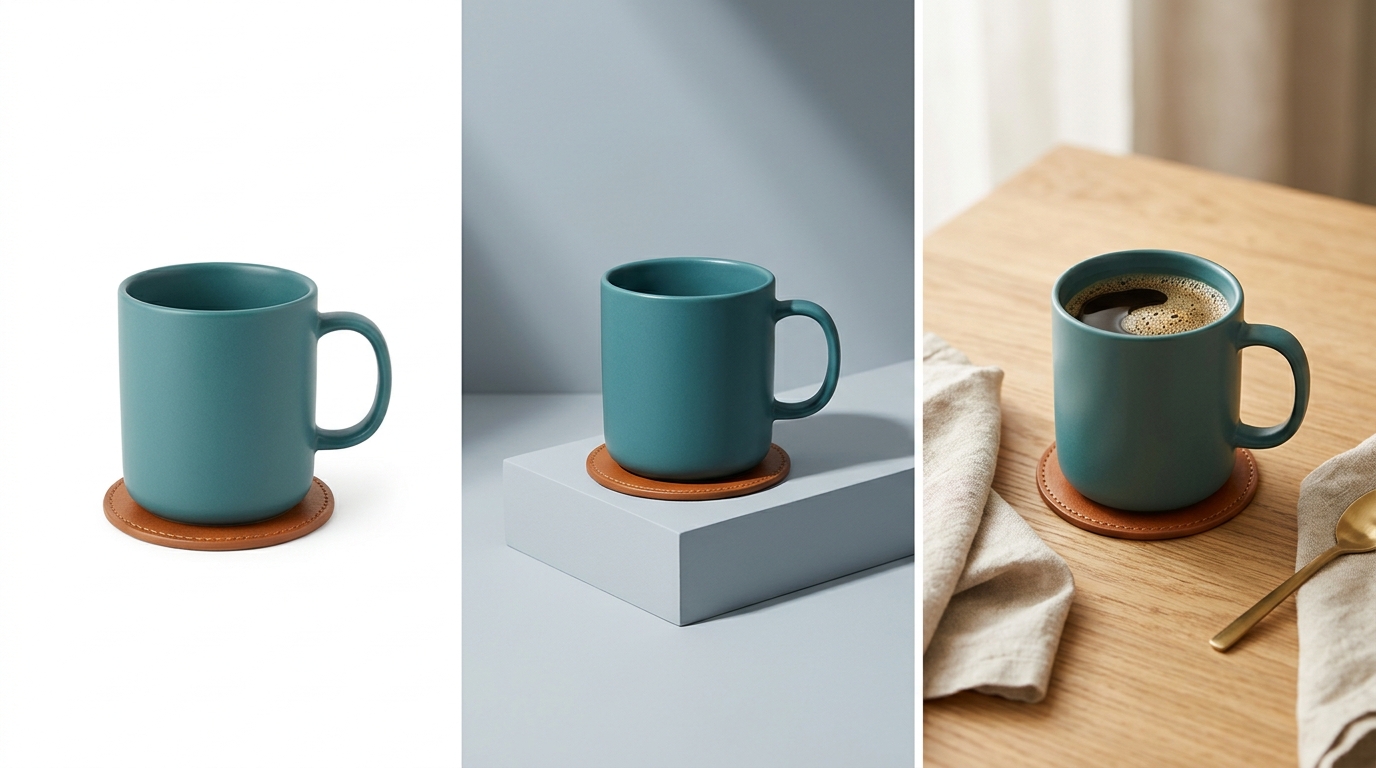
High-growth Shopify apparel and home brands frequently shoot one hero colorway and use professional Photoshop color correction and variant recoloring to generate 6 to 12 additional SKUs. Done properly with Pantone/hex calibration under Delta-E < 2.0, every colorway maintains identical framing, lighting, and shadow falloff when shoppers click swatch buttons—eliminating the jarring "jump" effect of reshot angles and cutting visual-mismatch returns by up to 40%.
4. Etsy Product Image Requirements (2026 Search & Thumbnail Mastery)
Etsy is a visual discovery engine where buyers browse dozens of thumbnails side by side before clicking a single listing. While Amazon rewards clinical white-background uniformity, Etsy rewards warm, tactile, lifestyle-first hero photos—provided they obey Etsy's strict thumbnail cropping math.
The 4:3 vs. 1:1 Etsy Thumbnail Trap
Etsy recommends uploading your primary listing photo at 2700 × 2025 px (4:3 horizontal) or 2000 × 2000 px (1:1 square) at 72 PPI. Here is the trap that catches thousands of sellers: Etsy's desktop search grid displays 4:3 thumbnails, while Etsy's mobile app, shop homepage, and Google Shopping feeds often crop that exact same first photo into a 1:1 square.
- Design for the Center Safe Zone: Keep your entire hero product cleanly inside the central square of a
4:3frame, with breathing room on the left and right edges. That way, when mobile search crops the sides to1:1, your product never loses a handle, earring hook, or frame corner. - Use All 10 Photo Slots + 1 Listing Video: Etsy's search ranking algorithm tracks engagement signals (clicks, favorites, dwell time). Pair your warm lifestyle hero (Slot 1) with a crisp clean-background studio detail shot (Slot 2), scale-in-hand reference (Slot 3), macro texture close-up (Slot 4), packaging/gifting shot (Slot 5), and color/size variation chart (Slot 6).
- Stay Under 1 MB for Crisp Uploads: Etsy accepts larger files, but keeping JPEGs between
350 KBand900 KBprevents Etsy's server-side re-compression from introducing blotchy artifacts into soft linen, wood grain, or pastel backgrounds.
5. Color Profiles (sRGB vs. AdobeRGB), DPI Myths & File Format Selection
Even experienced studio photographers lose conversions to invisible metadata mistakes. Fixing these three technical fundamentals eliminates 90% of "my photos look duller after uploading" complaints.
1. Always Convert to sRGB IEC61966-2.1 (Never Upload AdobeRGB or CMYK)
DSLRs and mirrorless cameras often capture in AdobeRGB or ProPhoto RGB to preserve a wider print gamut. When you upload an AdobeRGB or CMYK JPEG to Amazon, Shopify, or Etsy, most web browsers and marketplace image processors strip or ignore the wide-gamut profile and interpret the raw pixel numbers as sRGB. The result? Rich cognac leather turns muddy brown, vibrant crimson turns dull brick-red, and skin tones look desaturated and gray. Always run Edit → Convert to Profile → sRGB IEC61966-2.1 (8-bit) and check Embed Color Profile during export.
2. The 72 DPI vs. 300 DPI Web Myth
Web browsers and marketplace apps completely ignore the DPI/PPI metadata tag—only absolute pixel dimensions (2000 × 2000 px) matter on screen. Setting a 600 × 600 px image to 300 DPI does not make it higher resolution; it still fails Amazon's zoom check. Conversely, a 2000 × 2000 px file at 72 PPI displays with identical razor sharpness to a 2000 × 2000 px file at 300 PPI. Reserve 300 DPI strictly for physical print catalogs and packaging proofs.
3. JPEG vs. PNG vs. WebP: When to Use Each
- Baseline/Progressive JPEG (Quality 82–88): Default workhorse for 95% of Amazon, Shopify, and Etsy product photography. Delivers rich gradients and photographic detail at 1/5th the file weight of PNG.
- 24-bit Transparent PNG: Use only when genuine alpha transparency is required (e.g., floating graphics, brand logos, or Shopify hero banners placed over colored/gradient CSS blocks). Never upload full-size
2048 pxPNGs for standard white-background product galleries. - WebP (Quality 82–85): Ideal for custom storefronts, WooCommerce, and headless e-commerce builds—cuts file size by 25–35% vs. JPEG at visually identical sharpness. For Amazon and Etsy, stick to sRGB JPEG for universal ingestion compatibility.
6. Shadows, Cutouts & Visual Conversion Impact (2026 Benchmarks)
Compliance gets your product listed; commercial retouching craft gets it clicked and bought. Across multi-brand A/B tests on Amazon and Shopify catalogs, three post-production variables consistently outperform every other visual tweak: realistic grounding shadows, sub-pixel edge cleanliness, and high-resolution zoom clarity.
Benchmark Chart: Average E-Commerce Conversion & CTR Lift by Post-Production Upgrade
Observed relative performance lift when upgrading raw/AI-cutout catalog images to studio-grade commercial post-production:
Notice why natural contact shadows and mirror reflections matter so much: human vision uses micro-shadows beneath a shoe sole, handbag base, or glass bottle to judge physical weight and authenticity. When an automated AI background remover deletes the floor shadow completely, the product looks artificially pasted onto a white void—subconsciously triggering skepticism in luxury and mid-market buyers.
7. The 7-Stage Multi-Channel Pre-Upload Production Workflow
If your studio or e-commerce brand publishes 50 to 5,000+ SKUs per month, ad-hoc manual resizing creates costly inconsistencies. Follow this standardized 7-stage production pipeline—the exact SOP our senior retouchers execute inside Dinamico Studio's 24-hour workflow:
- Ingest 16-Bit RAW & Neutralize White Balance: Open CR3, NEF, ARW, or DNG captures in Adobe Camera Raw/Capture One. Neutralize lighting casts against an X-Rite ColorChecker reference frame before touching exposure or contrast.
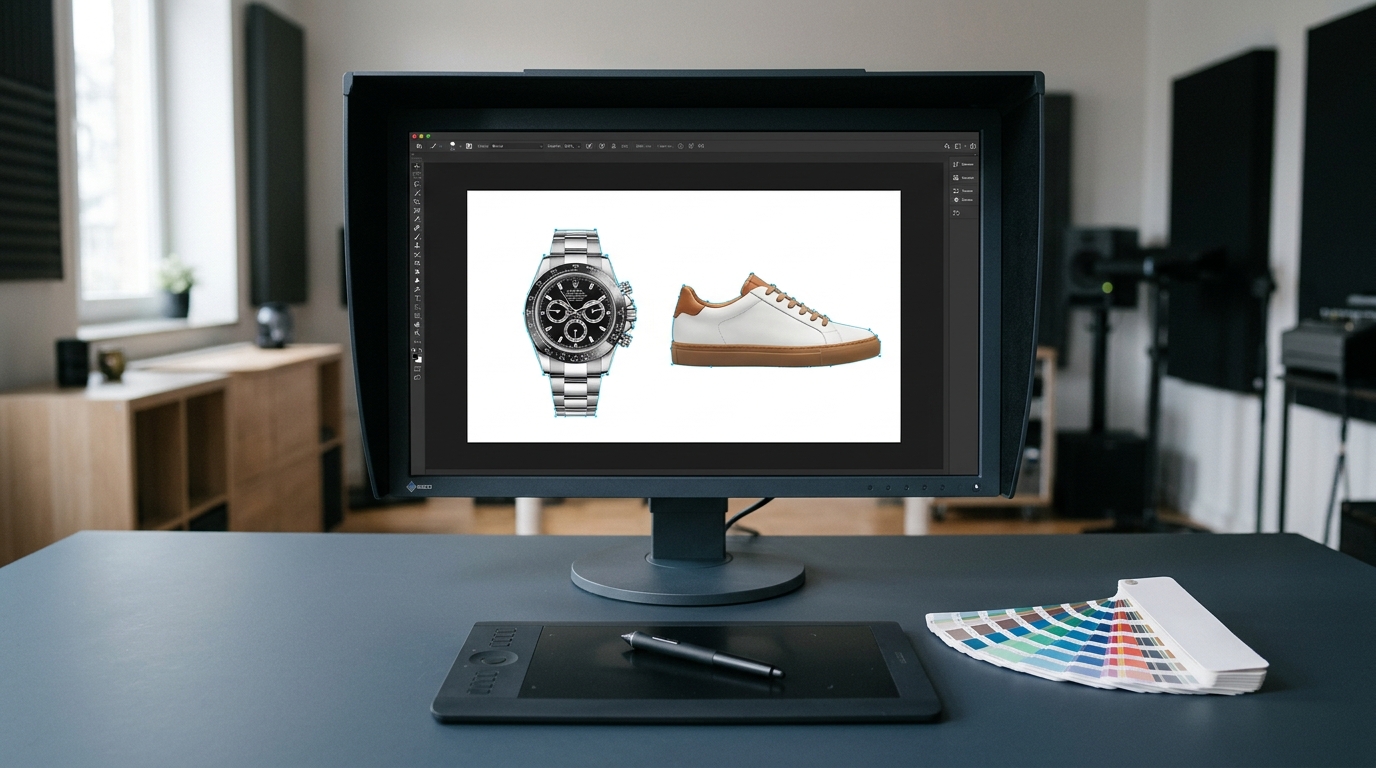
- Isolate with Hand-Drawn Paths or Alpha Masks: Plot a closed Pen Tool vector path 0.5px inside hard product contours (or build a non-destructive alpha-channel mask for hair, fur, lace, and transparent glass). Inspect at 200% zoom against black, 50% gray, and pure white check layers.
- Dust, Scratch, Wrinkle & Geometry Cleanup: Remove lint, sensor spots, glue residue, packaging dents, and studio rig reflections using 16-bit frequency separation and manual dodge-and-burn so leather grain, fabric weave, and metallic polish remain authentic.
- Calibrate Color & Generate Variants: Match primary SKU tones to physical swatches within
Delta-E < 2.0, then produce additional colorways via multi-layer luminance and curve masks via our color variant service. - Build Grounded Contact & Cast Shadows: Place a soft, directional contact shadow on an independent Multiply layer beneath the subject (and a subtle mirror reflection for glossy footwear, eyewear, or bottles).
- Apply Standardized Margin & Alignment Templates: Lock every product to an exact 85% bounding-box template (centered horizontally, consistent baseline vertically) so collection pages and Amazon carousels align with surgical precision.
- Batch-Export Channel-Specific Deliverables: Output
2000 × 2000 pxsRGB pure white JPEGs for Amazon,2048 × 2560 px(or2048 × 2048 px) web-optimized JPEGs for Shopify, and2700 × 2025 px4:3 lifestyle hero files for Etsy—named cleanly with SEO-friendly SKU slugs (e.g.,cognac-leather-tote-front.jpg).
8. Image SEO: Filenames, Alt Text & Structured Data for Google Images
Meeting marketplace upload specs is only half the battle—optimizing your image metadata unlocks free, high-intent buyer traffic from Google Images, Google Lens, and Shopping tabs:
- Descriptive Hyphenated Filenames: Replace camera defaults like
IMG_8492.jpgwith clean, keyword-accurate slugs such asmens-waterproof-leather-chelsea-boot-black.jpgbefore uploading to Shopify or Etsy. - Natural, Specific Alt Text (80–125 characters): Describe the product, material, color, and angle naturally—for example: "Black full-grain leather Chelsea boot with natural contact shadow on pure white background, 45-degree side angle." Avoid keyword stuffing.
- Consistent Canonical Aspect Ratios: Google Lens visual search matches clean, uncropped, uncluttered product photos far more accurately than busy collages—giving well-retouched white-background and editorial shots a major discovery advantage.
9. The 7-Point Pre-Upload Marketplace QA Checklist
Run every final batch through this quick 60-second verification before pushing live to Seller Central, Shopify Admin, or Etsy Shop Manager:
- Pixel Verification: Confirm Amazon Main background corners read exact
R:255 G:255 B:255with the Photoshop Info Eyedropper (not 253 or 254). - Edge Halo Audit: Toggle a temporary
#000000black check layer behind transparent/masked edges to catch hidden white fringing before flattening. - Zoom Sharpness Check: View at 100% actual pixels (`2000px+`) to verify labels, stitching, and gemstones are crisp without over-sharpening halos.
- Frame Fill & Safe Zone: Confirm 85%+ fill for Amazon and centered
1:1safe-zone framing for Etsy4:3hero shots. - ICC Color Profile: Verify
sRGB IEC61966-2.1is embedded and bit depth is 8-bit/channel. - File Weight Ceiling: Confirm Shopify JPEGs sit under
400 KBand Etsy JPEGs sit under1 MB. - Filename & Alt Text: Confirm hyphenated, lowercase SKU/product filenames with zero spaces or special characters.
Need Guaranteed Amazon, Shopify & Etsy Compliance at Scale?
Stop fighting AI cutout halos, suppressed ASINs, and mismatched collection grids. Our dedicated Photoshop specialists deliver 100% hand-drawn clipping paths, pure white RGB 255,255,255 cutouts, ghost mannequin composites, and natural shadows starting at $0.29/image with 12–24 hour turnaround.
10. Frequently Asked Questions (FAQ)
What is the single best universal product image size for Amazon, Shopify, and Etsy in 2026?
2000 × 2000 px (1:1 square, sRGB JPEG under 500 KB) is the closest universal workhorse—it triggers Amazon's high-res hover zoom, fits Shopify's square themes cleanly, and passes Etsy's 2000px minimum. For maximum performance, however, export a dedicated 2048 × 2560 px (4:5) version for mobile-first Shopify fashion stores and a 2700 × 2025 px (4:3) lifestyle version for Etsy's primary search slot.
Why did Amazon suppress my listing when my background already looks white?
Amazon's automated compliance scanner checks exact pixel RGB values at the image perimeter. Studio paper sweeps typically register around RGB 242–249, which looks white to human eyes but fails the strict RGB 255, 255, 255 check. Isolating the product with a manual clipping path onto a true #FFFFFF layer resolves suppression immediately.
Should I upload PNG or JPEG product photos to Shopify?
Upload high-quality sRGB JPEGs (Quality 82–85, 180–380 KB) for almost all product photos. Shopify's CDN automatically converts them to WebP/AVIF for shoppers, and starting with a clean JPEG avoids multi-megabyte uploads that slow down admin imports and uncached first loads. Reserve PNG strictly for transparent overlays and brand logos.
Why do my product photos look dull or washed out after uploading to Etsy or Amazon?
That is almost always caused by uploading an AdobeRGB, ProPhoto RGB, or CMYK file instead of sRGB IEC61966-2.1. Converting your master file to 8-bit sRGB and embedding the color profile before saving preserves exact saturation and hue accuracy across Chrome, Safari, and mobile apps.
Are shadows allowed on Amazon main product images?
Yes—subtle, realistic natural or soft contact shadows directly underneath the product are permitted and strongly recommended on Amazon as long as the shadow fades cleanly into exact RGB 255, 255, 255 pure white well before the edges of the image frame.
Can one photo shoot supply compliant images for Amazon, Shopify, and Etsy simultaneously?
Yes. By shooting high-resolution 16-bit RAW frames and building one layered master PSD with a vector clipping path and editable shadow layer, a commercial post-production studio can output Amazon pure-white 1:1 JPEGs, Shopify 4:5 editorial crops, and Etsy 4:3 lifestyle composites from a single shoot—saving 60%+ on studio production costs.
Related Photo Editing Guides

Jewelry Photo Retouching in 2026: The Complete...
Jewelry photo retouching is the specialized commercial post-production discipline of eliminating...
Read Guide »
Background Removal for E-commerce Product Photos...
Studio Production Standard Need 100% Marketplace-Compliant Background Removal in Bulk? Send us your...
Read Guide »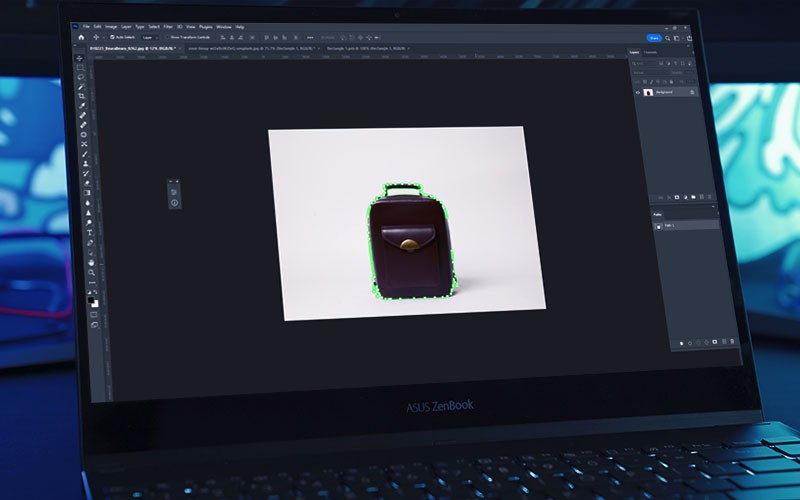
The Secret Weapon of Clipping Paths in Visual Content
A clipping path, often referred to as a "clipping mask" or "vector mask," is a technique used in graphic...
Read Guide »