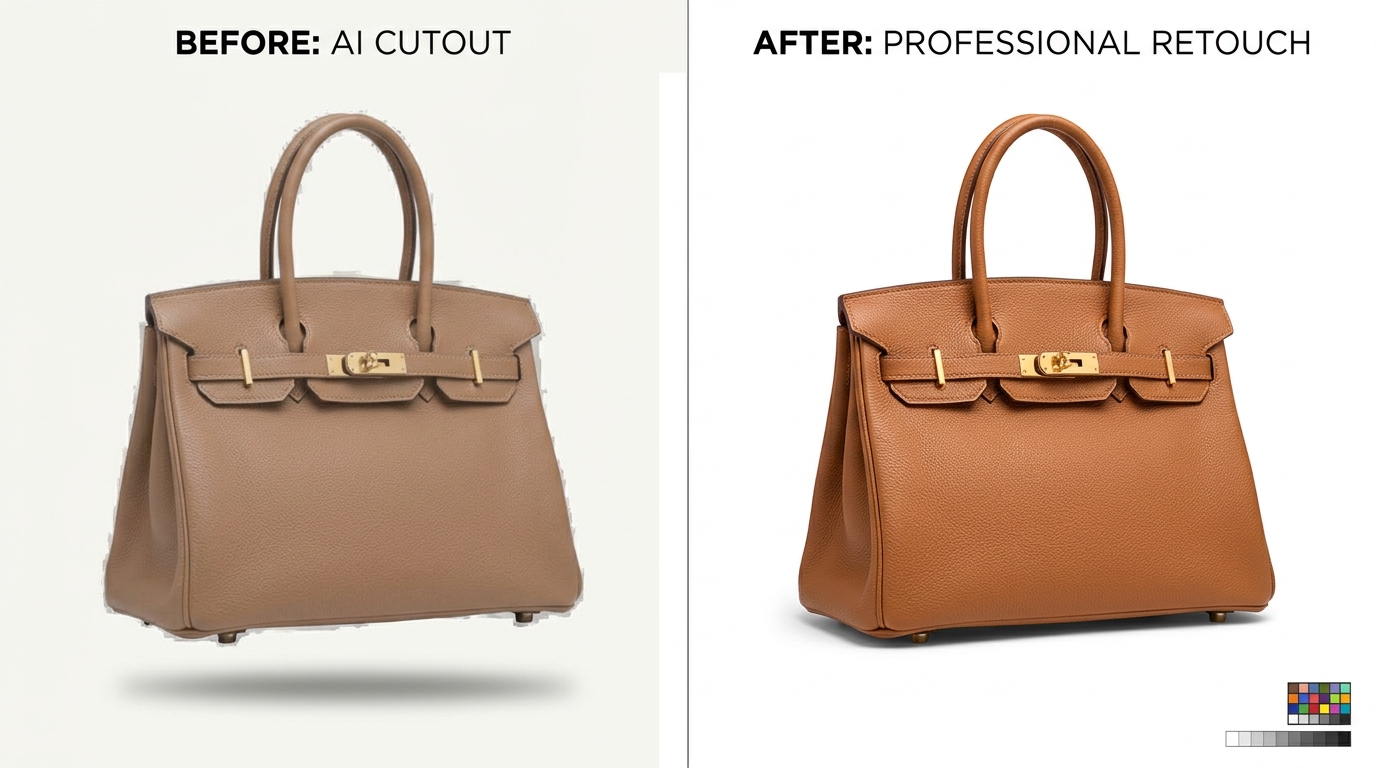
In 2026, over 22% of online apparel and commercial product returns stem directly from a single avoidable issue: the delivered item does not match the product image on the screen. While automated generative AI tools promised instantaneous background removal and catalog batching, retail brands quickly uncovered the hidden cost: washed-out textures, synthetic color shifts, blown-out metallic reflections, and telltale plastic halos. To protect margins and elevate customer trust, leading global brands are abandoning fully autonomous AI in favor of a Hybrid Retouching Architecture—pairing modern algorithmic throughput with handcrafted vector clipping paths, Delta-E color-calibrated swatches, and human QA inspection. In this master guide, we explore the engineering behind the "Zero-Return Image" and how precision post-production cuts retail return rates by up to 38%.
Tired of High Return Rates Caused by Inaccurate Product Images?
Send us your raw packshots for a free 3-image calibration test with 100% color-match guarantee and 24-hour turnaround.
1. The Anatomy of a High-Return Image: Why Pure AI Fails Commercial Retail
Generative AI models and browser-based background removers excel at speed, but e-commerce is not a contest of speed alone—it is an economic equation of accuracy and customer expectation. When an online shopper views a pair of Italian leather boots or an 18k gold necklace, every micro-pixel communicates value and texture.
When automated algorithms process commercial imagery without human color management, four catastrophic failure modes regularly occur:
- Color Shifts & Gamut Compression (Delta-E > 4.0): AI algorithms frequently remap subtle undertones (such as olive green, navy, or terracotta) into generic primaries. The customer orders what appears to be warm camel leather, but opens a box containing cool taupe. The result is an immediate return and a lost customer.
- Edge Fringing & "Ghost Halos": Algorithmic segmentations blur edge contrast to avoid jagged lines. This leaves a 1-to-2 pixel milky fringe around product borders that looks amateurish on dark mobile browsers and fails strict marketplace zoom audits.
- Loss of Organic Surface Texture: AI neural filters treat organic imperfections (leather pore structure, cashmere weave, matte metal brushed finishes) as "noise" and smooth them away, transforming premium luxury goods into cheap plastic representations.
- The "Floating Product" Syndrome: Automated background removers uniformly erase natural contact shadows. Placing an unanchored product on pure white canvas creates optical dissonance, reducing buyer confidence at the critical point of purchase.
For brands looking to master clean cutouts without edge degradation, our cornerstone guide on Background Removal for E-Commerce Product Photos provides an exhaustive breakdown of vector Bézier curves versus raster masking techniques.
2. The 5-Stage "Zero-Return" Retouching Pipeline
To achieve zero-return fidelity at scale, commercial studios operate on a rigorous 5-stage sequential pipeline. This framework pairs initial batch preparation with dedicated human artistry and color calibration:
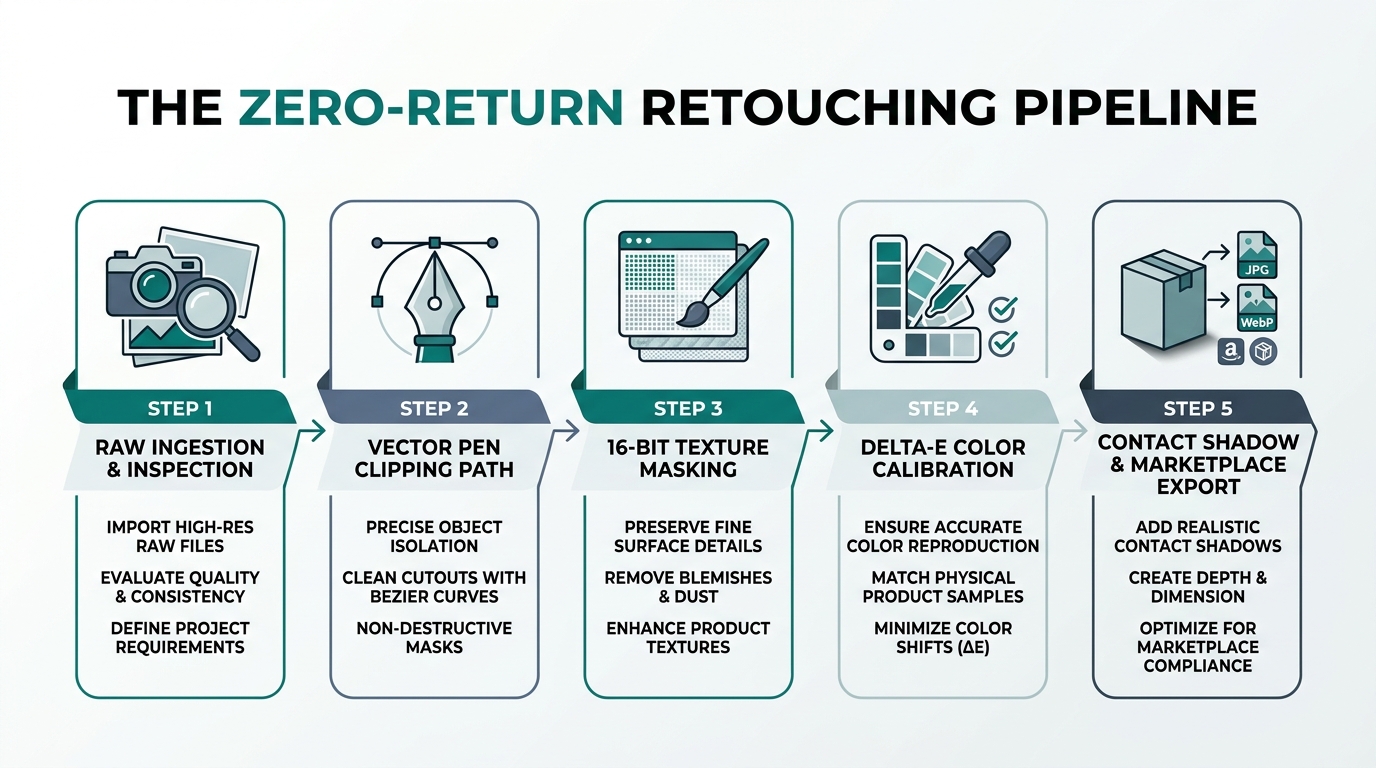
Figure 2: The end-to-end studio workflow that ensures zero color discrepancy and marketplace compliance across thousands of daily SKUs.
Stage 1: RAW Ingestion & 16-Bit Inspection
Every high-fidelity workflow begins by ingesting uncompressed 14-bit or 16-bit RAW camera files. By maintaining maximum dynamic range, retouchers can recover subtle highlight roll-offs on glossy ceramics and retrieve deep shadow details in black fabrics without introducing banding or chromatic noise.
Stage 2: Handcrafted Vector Pen Clipping Paths
Unlike automated pixel selection tools, professional retouchers use the Photoshop Pen Tool (P) to construct mathematically precise closed vector paths. Anchoring Bézier points exactly 0.5 pixels inside the product boundary ensures that no background bleed contaminates the final cutout. For hard-edged merchandise like electronics, luxury footwear, and cosmetics, nothing matches the clean crispness of a dedicated vector clipping path service.
Stage 3: 16-Bit Alpha Channel Texture Masking
For garments with flyaway faux-fur trims, loose knits, sheer lace, or human hair, hard vector clipping paths are inappropriate. Retouchers calculate custom alpha luminosity channels to isolate micro-strands at the sub-pixel level. Through non-destructive image masking techniques, the product retains its genuine tactile drape without looking razor-sliced or artificial.
Stage 4: Delta-E Color Calibration & Swatch Matching
Color calibration is the single greatest defense against online returns. Retouchers utilize physical Pantone or X-Rite ColorChecker charts captured on set under standardized 5000K daylight lighting. By adjusting HSL curves against calibrated physical swatches, retouchers guarantee a Delta-E variance of less than 2.0—the threshold where the human eye cannot detect any difference between the physical product and its digital render. When launching multi-color SKU lines, brands leverage dedicated color change and variant editing services to produce dozens of exact colorways from a single master capture.
Stage 5: Organic Contact Shadow & Marketplace Export
Products must never look like they are floating in an empty void. In Stage 5, retouchers rebuild organic two-tier shadows: a tight, high-density contact shadow immediately beneath the base point of the item, transitioning into a soft, diffused cast shadow. Utilizing specialized drop shadow and reflection creation anchors the subject firmly to the canvas while meeting Amazon's strict RGB (255, 255, 255) pure white background criteria.
3. Symmetrical Ghost Mannequin Compositing for Fashion & Apparel
In online fashion retail, apparel returns reach staggering peaks of 30% to 40%, largely driven by poor fit visualization. Live model photography is expensive and often obscures garment construction, while flat-lay shots fail to demonstrate hollow depth and structure.
The solution preferred by world-class fashion houses is 3D Ghost Mannequin Compositing. By photographing the garment on a physical mannequin, shooting a secondary reverse shot of the interior neck and label, and seamlessly compositing the two layers together, retouchers create a structural 3D "hollow" presentation:
- Symmetrical Hem & Collar Alignment: Retouchers correct uneven collar sag, balance sleeve lengths, and remove distracting creases along the torso.
- Interior Label & Lining Visibility: Preserving original brand tags, sizing embroidery, and inner lining patterns gives buyers immediate confidence in garment authenticity.
- Accurate Fabric Drape: Unlike 3D digital avatars that look rigid, composite ghost mannequin apparel retouching honors the natural gravity, stretch, and texture of the original textile.
4. The Economics of Color Accuracy: Lowering Returns from 22% to <4%
High return rates are a direct drain on e-commerce profitability. According to National Retail Federation (NRF) benchmarks, processing a single returned item costs online retailers an average of $15 to $30 in reverse logistics, inspection, repackaging, and inventory depreciation.
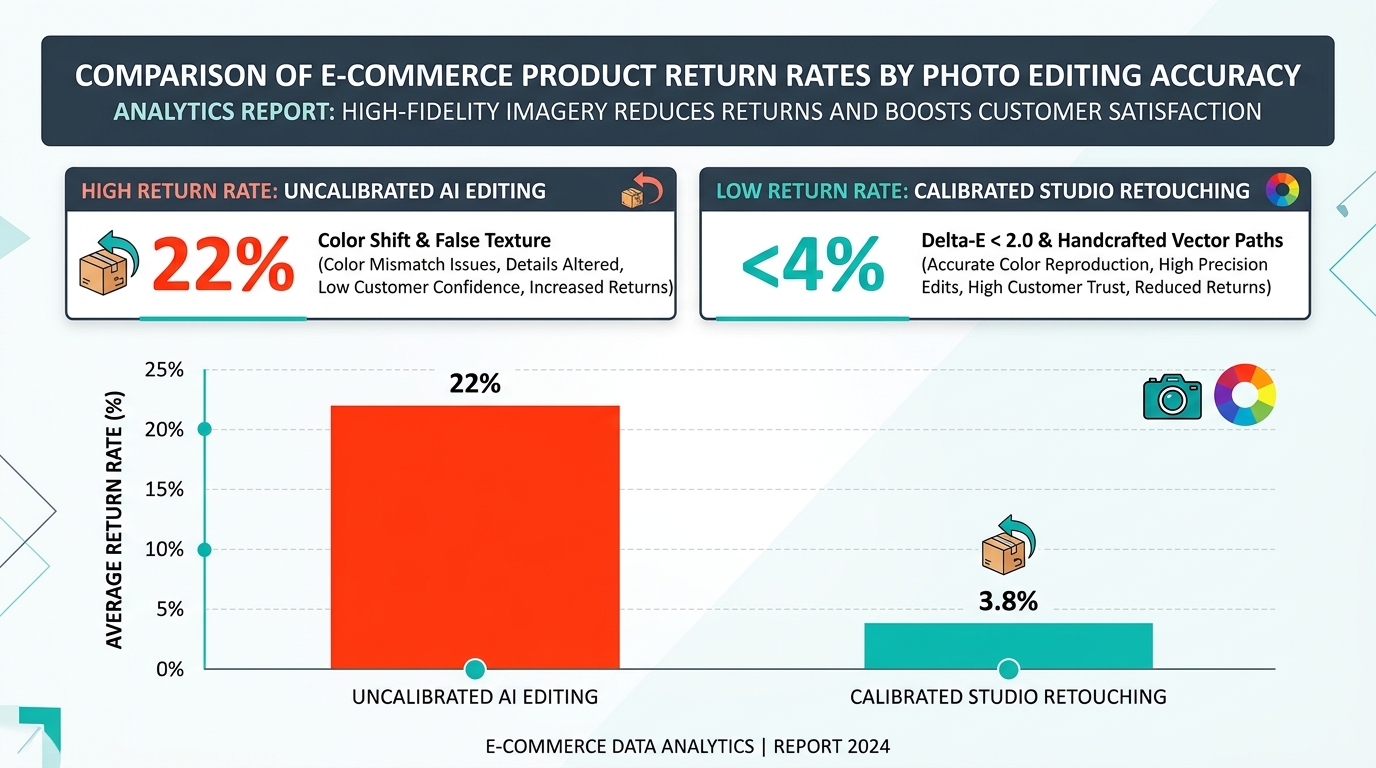
Figure 3: E-commerce return rate analytics showing a dramatic reduction from 22% down to 3.8% when switching from uncalibrated AI to studio color-calibrated retouching.
Consider an e-commerce brand generating 10,000 monthly orders with an average order value (AOV) of $85:
| Metric | Uncalibrated AI / Budget Editing | Calibrated Studio Retouching | Net Financial Impact |
|---|---|---|---|
| Return Rate (Visual Mismatch) | 22.0% (2,200 returns/month) | 3.8% (380 returns/month) | -18.2% Reduction |
| Reverse Logistics Cost ($22/return) | $48,400 / month | $8,360 / month | +$40,040 Saved / Month |
| Depreciated Inventory Write-Downs | $18,700 / month | $3,230 / month | +$15,470 Saved / Month |
| Annual Margin Improvement | Direct savings across shipping, restocking, and customer retention | +$666,120 / Year | |
Investing $1.50 to $3.50 per image in professional post-production pays for itself hundreds of times over by shielding your bottom line from the catastrophic drain of customer returns.
5. Marketplace Compliance Checklist: Amazon, eBay, Shopify & Google Shopping
Publishing non-compliant product assets can result in algorithmic listing suppression, search penalty, or complete ad rejection on Google Shopping. Here is your definitive 2026 technical compliance checklist:
| Platform | Background Standard | Dimensions & Zoom | Frame Coverage | Color Space & Format |
|---|---|---|---|---|
| Amazon (Hero MAIN) | Pure White: RGB (255, 255, 255) / Hex #FFFFFF | 1600px – 2560px on longest side | Product must occupy 85%+ of canvas | sRGB IEC61966-2.1 | JPEG (Quality 90+) |
| eBay | Neutral pure white or subtle off-white | 1600px minimum for 3x zoom tool | Product centered, no borders or promo text | sRGB | JPEG or WebP |
| Shopify / DTC Web | Clean white, transparent, or curated lifestyle hex | 2048 x 2048px square or 4:5 mobile portrait | 75% – 85% frame fill with uniform padding | sRGB | Modern WebP (Quality 85) for sub-second LCP |
| Google Shopping Feed | Solid white or gray background (no illustrations) | 1000 x 1000px minimum (non-apparel), 250px min | Complete uncropped view of primary item | sRGB | JPG, PNG, or WebP (max 16MB) |
6. The 4-Point Studio QA Checklist: How Dinamico Studio Ensures 100% Accuracy
Before any batch of catalog assets is delivered to our clients, our senior quality control directors run every image through a standardized 4-point verification protocol:
- The 3-Background Contrast Test: Every isolated cutout is previewed against 100% black (Hex #000000), 50% neutral gray (#808080), and pure white (#FFFFFF). Any lingering fringing, jagged pixelation, or background bleed immediately becomes visible and is eliminated.
- 300% Vector Edge Inspection: Retouchers zoom in to 300% magnification to inspect corner anchors, bevel transitions, and thin elements (such as watch hands, handbag strap buckles, and jewelry prongs).
- X-Rite Digital Swatch Verification: The digital RGB readouts of the product's primary surface are sampled and cross-checked against physical manufacturer swatches to guarantee zero color drift.
- Shadow Density & Falloff Check: Retouchers verify that the contact shadow is set to Multiply blending mode, preventing dark muddy overlays when placed over different website background hues.
7. Frequently Asked Questions (FAQ)
How does inaccurate photo retouching increase e-commerce return rates?
When product photos suffer from uncalibrated RGB color shifts, artificial smoothing, or missing contact shadows, customers form an inaccurate perception of the item's texture, weight, and true hue. Upon delivery, the physical mismatch triggers an immediate return, which costs brands an average of $22 per return in shipping and restocking fees.
What is Delta-E color accuracy and why is it crucial for online sales?
Delta-E is the scientific metric used to measure color difference between a reference swatch and a digital image. A Delta-E value of less than 2.0 is imperceptible to the human eye, ensuring that garments, cosmetics, and home goods look identical on screen to the physical product in the customer's hands.
Why are automated AI background removers insufficient for luxury and jewelry goods?
Automated AI tools rely on edge contrast heuristics that fail on complex specular surfaces. In jewelry and luxury accessories, AI often erases gemstone prongs, blurs metallic reflections, and clips delicate chains. Professional jewelry retouching requires manual vector pen clipping and micro-dust cleanup to maintain high perceived value.
What is the turnaround time for bulk commercial photo retouching?
At Dinamico Studio, our 24/7 dedicated production studio processes batches of 500 to 5,000+ images within 24 hours. Enterprise clients benefit from dedicated account managers, custom color profiles, and automated secure FTP/API pipelines.
How can I test Dinamico Studio's retouching quality before placing a large order?
You can request a free sample calibration test directly on our Get a Quote page. Simply upload up to 3 raw product photos with your technical instructions, and our senior colorists will deliver fully retouched, marketplace-compliant proofs within 45 minutes to 2 hours.
Elevate Your Catalog with Zero-Return Product Retouching
Join over 1,200+ global brands, Amazon top sellers, and commercial photography studios who rely on Dinamico Studio for pixel-perfect clipping paths, ghost mannequin compositing, and color calibration.


