For fashion, apparel, and activewear brands, on-model product photography has always been the single highest-converting asset on a Product Detail Page (PDP)—and the single biggest operational bottleneck in seasonal merchandising. Booking a commercial London or New York studio, agency talent, hair and makeup artist, stylist, digital tech, and photographer routinely costs $4,500 to $8,500 per shoot day and locks teams into a 10-to-18-day turnaround before a single SKU goes live on Shopify, Zalando, or Amazon Fashion.
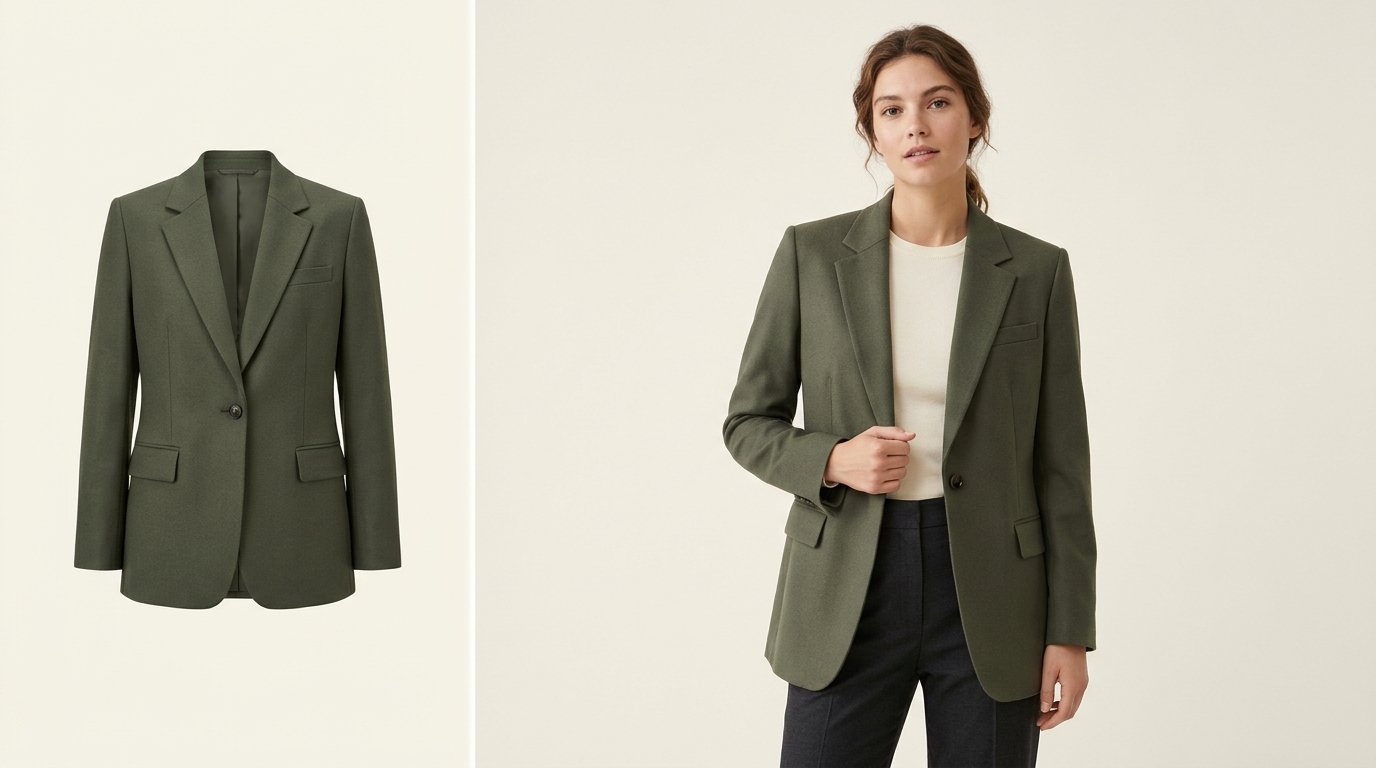
In 2026, enterprise AI Virtual Try-On (VTO) paired with senior human retouching QA has fundamentally rewritten apparel post-production economics. Instead of organizing a five-figure studio shoot every time a capsule colorway, restock, or extended size run arrives, merchandising teams can photograph clean flat-lay or 3D ghost mannequin garments once and render photorealistic on-model catalog imagery across diverse studio models in minutes—while reserving traditional shoots for flagship brand campaigns. This studio manual breaks down the real 2026 cost-per-look math, PDP conversion and return-rate benchmarks, honest AI limitations, pre-shoot input SOPs, and the 7-point commercial QA checklist that separates luxury editorial catalogs from obvious synthetic outputs.
1. The Real 2026 P&L: Traditional On-Model Photoshoot vs. Hybrid AI Virtual Try-On
When creative directors compare traditional photography against AI Virtual Try-On, they frequently compare only the photographer's day rate against a software subscription. In real commercial e-commerce operations, a 40-SKU seasonal apparel drop requires coordinating six separate vendor invoices—plus physical garment logistics, steaming, sample shipping delays, and post-production retouching for every selected frame.
Even if a brand runs a lean, disciplined one-day studio production in London, Manchester, Los Angeles, or Berlin shooting 40 garments on a single agency model (two angles per garment = 80 selects), the fully loaded production ledger consistently clears $4,850 per drop before paid media even turns on. Compare that side-by-side against a Hybrid AI Virtual Try-On + Human QA Studio workflow for the exact same 40-SKU drop (80 finished on-model images):
Notice what happens to a brand's marketing velocity when per-drop catalog cost falls from $4,850 to under $100: instead of delaying new-arrival launches for two weeks until enough SKUs accumulate to justify studio rent, merchandisers can publish weekly micro-drops of 8 to 15 SKUs the exact afternoon factory samples hit the warehouse. In fast-moving apparel e-commerce, capturing 12 extra selling days at full retail margin before seasonal markdowns often generates more incremental gross profit than the photography savings itself.
Per-Look Production Cost & Turnaround Across 4 Apparel Workflows
2. PDP Conversion Rate & Fit-Return Benchmarks: Flat Lay vs. Ghost Mannequin vs. On-Model
Lower production cost means nothing if an image format depresses conversion rate or increases size-related returns. Across Shopify Plus, WooCommerce, and European fashion marketplaces (Zalando, ASOS, About You), apparel shoppers rely on visual cues that static flat lays simply cannot communicate: shoulder drop, sleeve cuff length, hemline fall relative to the hip, fabric weight, and silhouette proportion on a real human body.
As we documented in our Zero-Return E-Commerce Retouching Study, apparel returns average 24% to 35% online, with "looked or fit differently than pictured" cited as the #1 driver. Pairing clean technical product shots (ghost mannequin or pure-white flat lay) with authentic on-model imagery resolves both shopper anxieties simultaneously: the technical shot proves construction and color fidelity, while the on-model frames answer "how will this actually drape on someone my build?"
| PDP Visual Strategy | Avg. PDP Conversion Lift | Fit / Visual Return Impact | Production Speed (40 SKUs) | Best Commercial Role |
|---|---|---|---|---|
| Flat Lay / Hanger Only | Baseline (1.0x) | Highest fit uncertainty | 1–2 days | Basic accessories, folded knitwear, secondary gallery |
| 3D Ghost Mannequin Only | +14% to +22% | -8% to -12% returns | 12–24 hours | Amazon Main RGB 255 white compliance & wholesale line sheets |
| Single-Model Studio Shoot | +24% to +34% | -15% to -21% returns | 12–16 business days | Hero lookbooks, brand campaigns, high-motion editorial |
| Hybrid: Ghost Mannequin + Multi-Model AI VTO | +31% to +42% | -22% to -30% returns | Same day (2–6 hrs) | Full Shopify/DTC catalog, weekly drops & multi-colorway scaling |
3. Multi-Model Casting & Size Representation Without Tripling Your Shoot Budget
One of the most decisive commercial advantages of AI Virtual Try-On in 2026 has nothing to do with cutting corners—it is unlocking inclusive multi-model casting that was previously financially impossible for mid-market brands. Under traditional photography, showing every dress, trench coat, or blazer on three different models (for example, Petite 5'3", Tall 5'10", and Curvy Size 14, or diverse regional casting for US, UK, and EU storefronts) triples model agency fees, booking overhead, and studio days—pushing a single 40-SKU drop past $14,000.
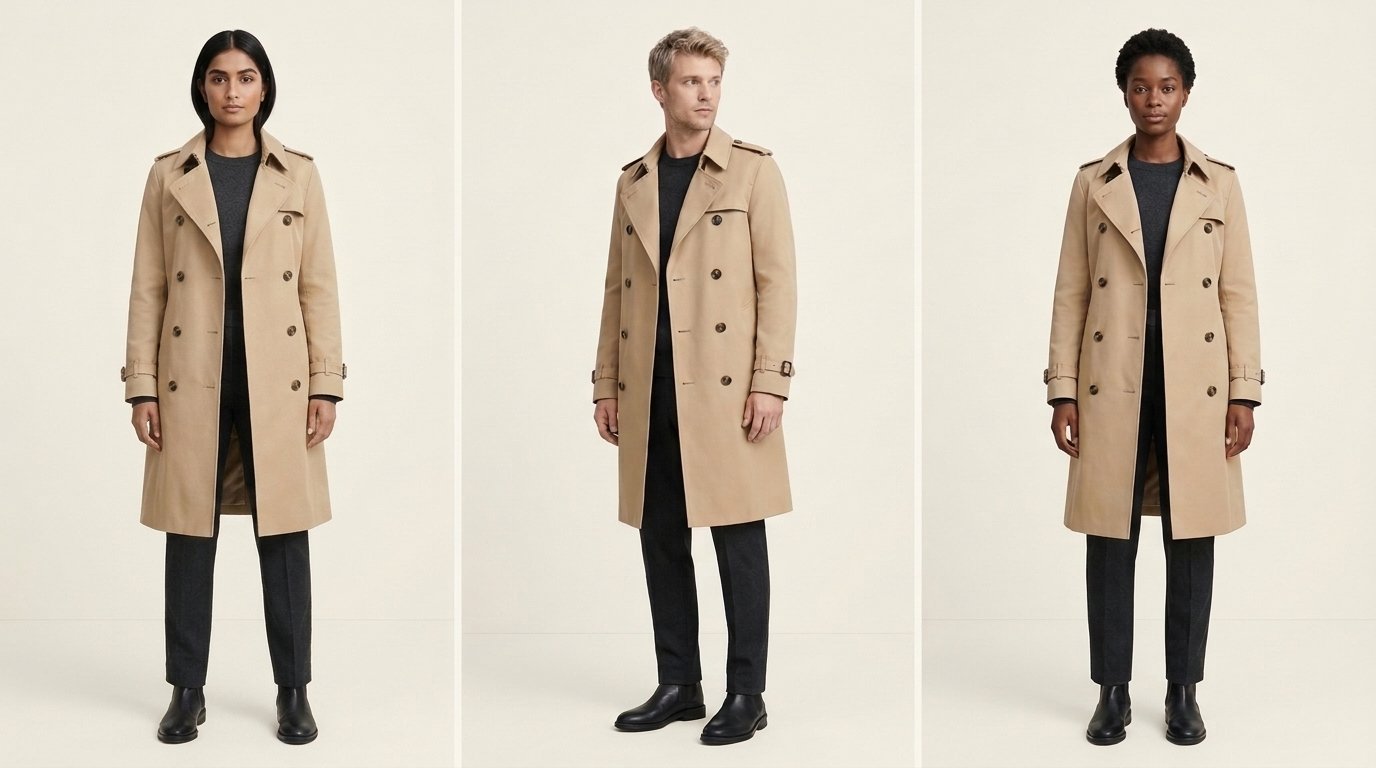
With a studio-grade Virtual Try-On pipeline—such as Dinamico AI Studio's curated cast & custom brand model roster—brands photograph the garment once and cast it across consistent studio models or their own proprietary brand model in front, three-quarter, and back studio angles. Even better, your visual identity stays locked across seasons: the lighting temperature, cyclorama ivory tone, lens compression (85mm portrait look), and framing ratio stay 100% uniform from January winter coats to July linen resortwear.
4. Honest Decision Matrix: When AI Virtual Try-On Wins vs. When You Still Need a Traditional Shoot
As a hybrid studio that delivers both instant AI rendering and hand-crafted human retouching for thousands of commercial SKUs, we give creative directors an honest rule of thumb: AI Virtual Try-On is not a blanket replacement for every photograph your brand makes. Knowing exactly where each workflow excels protects brand prestige while maximizing ROI.
| Campaign or Product Category | Recommended Workflow | Why This Wins in 2026 |
|---|---|---|
| Core E-Commerce Apparel (Tops, Blazers, Dresses, Coats, Knitwear) | AI Virtual Try-On + QA | 98% savings, same-day PDP publishing, effortless multi-model & colorway expansion |
| Multi-Colorway Drops (5–15 Colors per Style) | 1 Base Look + Recolor / VTO | Eliminates re-steaming and re-shooting identical silhouettes across Pantone swatches |
| Amazon / Zalando Main Image Compliance | 3D Ghost Mannequin + BG Cutout | Meets strict pure-white RGB 255 & 85% product-fill marketplace rules cleanly |
| Intricate Micro-Text, Sequins, Sheer Lace & Luxury Embroidery | Hybrid: AI VTO + 1-Click Human Retouch | AI builds the natural pose & drape; senior retoucher restores crisp embroidery & logos |
| Flagship Hero Brand Campaigns, Outdoor Location & Video Reels | Traditional Location Shoot | Emotional storytelling, kinetic fabric motion, and bespoke art direction still shine live |
| Fine Jewelry, Watches & Reflective Eyewear Close-Ups | Macro Shoot + Human Retouching | Sub-millimeter facet fire, metal engravings, and optical reflections require macro capture |
5. Worked 2026 ROI Case Studies Across Three E-Commerce Tiers
To make budget allocation concrete for founders, heads of e-commerce, and CFOs, here is how three real-world apparel tiers restructure their annual photography spend using a hybrid model (calculated using Dinamico Studio's transparent credit and retouching rates):
35 SKUs / Bi-Monthly Drop
6 drops/year (420 on-model looks + 210 white-background cutouts).
180 SKUs / Month
Shopify + Zalando + Amazon (360 on-model looks/mo + 180 cutouts + 20% human QA polish).
1,200 SKUs / Season (4 Seasons)
4,800 SKUs/yr across 3 model builds per style + dedicated human QA pod.
Crucially, Tier 2 and Tier 3 brands do not eliminate live photography entirely—they reallocate 15% to 20% of those freed photography dollars into two high-impact editorial hero shoots per year (lifestyle location imagery, video reels, founder storytelling) while running 100% of repeatable catalog PDPs through their Hybrid AI + Human Retouching pipeline. That combination elevates brand equity while slashing fixed studio overhead—a strategy that pairs directly with our In-House vs. Outsourced Photo Editing Cost Benchmark.
6. The Hybrid AI + Human QA Bridge: Why Pure AI Alone Fails Luxury Apparel Standards
Every e-commerce director who tested early-generation AI try-on apps in 2024–2025 encountered the same five conversion-killing defects: slightly warped woven brand labels, softened fine pinstripe or houndstooth weaves, mismatched sleeve-hem proportions, unnatural finger geometry near jacket pockets, or subtle hue shifts (Delta-E > 4.0) that trigger customer color-mismatch returns.
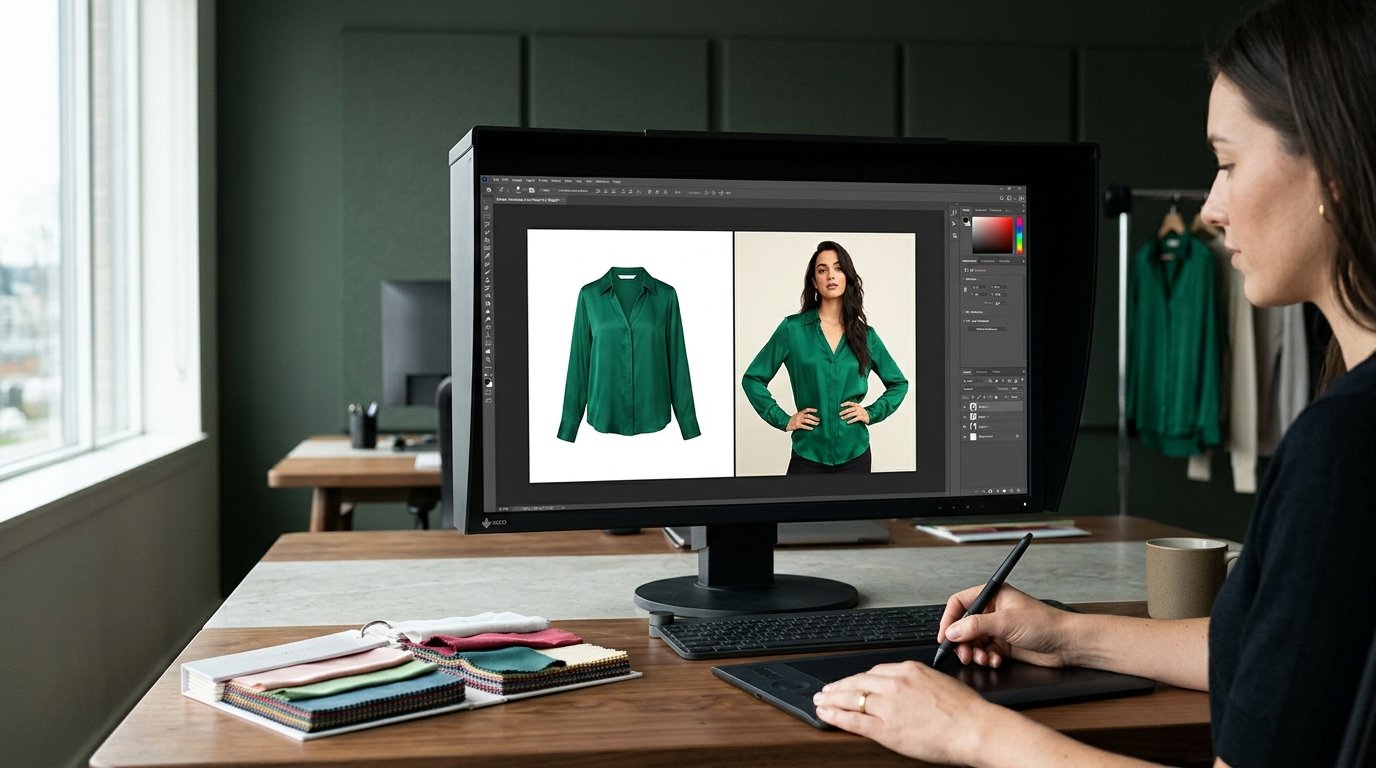
That is why pure self-serve AI tools hit a ceiling around 80% catalog usability—leaving internal teams frustrated with the remaining 20% of hero garments that need manual rescue. The modern enterprise solution is a Hybrid AI + Human QA Pipeline:
- Instant AI Generation (Minutes): Generate 100% of your seasonal SKUs onto consistent studio models (1K or 2K HD) with pre-isolated garment edges so hanger hooks, clips, and studio clutter never bleed into the neckline.
- Automated & Visual Triage: Roughly 80%–88% of clean solid-color, knit, denim, and outerwear looks pass commercial inspection on the first pass and publish straight to Shopify, WooCommerce, or Amazon.
- 1-Click Human Retoucher Escalation (Hero 12%–20%): For silk prints, embroidered chest logos, delicate lace hems, or exact Pantone color matching, click once to pin spot-retouching notes and send the asset—along with the original raw garment photo—directly to a senior Photoshop retoucher for pixel-accurate compositing and Delta-E < 2.0 calibration.
7. Pre-Shoot Input Garment SOP: How to Photograph Source Garments for 98% First-Pass VTO Realism
The single biggest predictor of photorealistic AI Virtual Try-On quality is source garment input discipline. You do not need an expensive studio—a clean daylight-balanced LED panel, a tripod, and a smartphone or mirrorless camera are sufficient—provided your team follows six non-negotiable capture rules:
- 1. Steam Thoroughly Before Shooting: Deep shipping creases confuse drape synthesis and carry awkward shadow lines onto the model's torso. A 60-second commercial steamer pass dramatically improves fabric realism.
- 2. Shoot Straight-On at 90 Degrees (Zero Perspective Tilt): Whether capturing a flat lay on a table or a garment on an invisible mannequin, keep the camera sensor strictly parallel to the garment plane so shoulder widths and hemlines stay proportionally true.
- 3. Capture Full Silhouette Without Cropped Sleeves or Hems: Never clip cuff edges, collars, or bottom hems against the frame border. Leave at least 8%–10% breathing margin on all four sides.
- 4. Use Diffused, Even 5500K Daylight Lighting: Harsh directional sunlight or mixed warm/cool overhead bulbs bake hard shadows onto the fabric that clash with the studio model's softbox lighting.
- 5. Enable Pre-Isolation Cutout: Remove messy hangers, mannequin neck poles, or wooden tables before conditioning the try-on render so stray background artifacts never transfer onto the model's collarbone.
- 6. Match Garment Silhouette to Target Outfit Slot: Upload clean single tops, dresses, or coats for Single-Garment VTO, or pair structured top + bottom separates cleanly for Full Outfit Ensemble boards—avoid stacking layered scarves or handbags on top of the source garment.
8. The 7-Point Commercial QA Checklist Before Publishing AI On-Model PDPs
Before any on-model catalog batch moves from staging to live storefront—especially across strict marketplaces covered in our 2026 Amazon, Shopify & Etsy Spec Sheet—your e-commerce QA lead should audit every look against seven concrete checkpoints:
- Delta-E Fabric Color Fidelity (< 2.0): Compare the rendered garment side-by-side against the physical sample or raw garment file on an sRGB monitor. Watch specifically for navy shifting toward black, warm ivory turning cool grey, or olive shifting yellow.
- Collar, Placket & Button Symmetry: Zoom to 200% around collar tips, lapels, zippers, and button spacing. Confirm button counts match the real garment—especially on tailored blazers and trenches.
- Print, Stripe & Logo Legibility: Verify chest monograms, pocket embroidery, and patterned weaves follow natural body contour without garbled lettering. Escalate any distorted brand mark for quick 1-click human label compositing.
- Hemline & Sleeve Proportion Accuracy: Confirm cropped jackets stay cropped, midi skirts land below the knee, and sleeve cuffs hit the wrist accurately so shoppers do not receive unexpected fit lengths.
- Hands, Fingers & Hair-Over-Shoulder Transitions: Inspect where hair meets the collar and where hands rest near pockets or waistlines to guarantee 100% natural anatomy and clean edge blending.
- Consistent Studio Backdrop & Crop Alignment: Verify uniform eye-level alignment and identical head-to-frame margin across your collection grid so your Shopify collection page reads like a single cohesive editorial shoot.
- Exact SKU Filename & Multi-Channel Export Integrity: Preserve exact original SKU stems (e.g.,
AW26-BLZ-042.jpg) and export in sRGB WebP/JPG at 4:5 (Shopify), 3:4 (Zalando), and 1:1 (Amazon) so PIM and storefront sync runs without broken links.
9. The 4-Week Fashion Studio Rollout Plan (Zero-Risk Pilot to Full Catalog)
Transitioning a fashion brand from 100% traditional studio shoots to a Hybrid AI + Human QA production engine works best as a measured 30-day experiment backed by live storefront analytics:
- Week 1 — Cast Your Core Studio Roster & Brand Spec Sheet: Select 2 to 3 consistent studio models (or upload your own contracted brand model) and lock your backdrop tone, framing ratio (4:5 Shopify / 3:4 EU lookbook), and sRGB export profile.
- Week 2 — Run a 15-SKU Split-Test Drop: Take 15 incoming SKUs currently photographed only as flat lays or ghost mannequins, generate 1K/2K on-model looks, and run 1-click human retouching QA on the 2–3 most intricate patterned styles.
- Week 3 — Measure Live PDP Metrics: Track Add-to-Cart rate, scroll depth, time-on-PDP, and first-14-day return codes against your prior flat-lay-only baseline. Most apparel brands record an immediate +18% to +35% Add-to-Cart lift on previously model-less SKUs.
- Week 4 — Automate Weekly Drops & Reinvest Into Hero Campaigns: Move all routine seasonal drops, restocks, and extended colorway launches onto your Hybrid AI Studio workflow—freeing your creative budget for two flagship seasonal brand shoots per year.
10. Frequently Asked Questions on AI Virtual Try-On & Fashion Photography
How much does AI Virtual Try-On cost per image compared to a traditional photoshoot in 2026?
A traditional commercial on-model photoshoot averages $64 to $121+ per finished look once studio rent, agency model day rates, photographer, stylist, makeup, and retouching are included. Enterprise AI Virtual Try-On costs $0.57 to $0.90 per high-definition look (depending on 1K vs. 2K resolution and plan tier), cutting catalog production costs by over 95%.
Will AI Virtual Try-On preserve my garment's exact fabric texture, color, and stitching?
Modern studio-calibrated VTO pipelines preserve fabric weave, drape, and overall color with high accuracy when fed clean, steamed, straight-on source photos. For microscopic embroidered logos, intricate typography, or strict Pantone Delta-E < 2.0 requirements, a hybrid 1-click human retoucher pass guarantees 100% exact brand-mark fidelity.
Can I use my own brand's contracted fashion model instead of generic stock models?
Yes. Enterprise AI studios let you upload a clean full-body studio photo of your own contracted model (with model release consent) to create a private, workspace-exclusive cast—ensuring total visual continuity across your entire storefront and paid social ads.
Do Amazon, Shopify, and Zalando allow AI Virtual Try-On product photos?
Shopify and WooCommerce allow on-model VTO imagery freely across PDPs and lookbooks. Amazon requires pure-white RGB 255 product-only cutouts (such as ghost mannequin or flat lay) for the primary Main Image in many apparel subcategories, while welcoming on-model VTO imagery in secondary gallery slots and A+ Brand Story modules.
What input photo format produces the sharpest AI Virtual Try-On results?
High-resolution (1500px+ wide) straight-on flat-lay or ghost mannequin photos in JPG, PNG, or WebP shot under even 5500K diffused lighting with the garment fully steamed and uncropped produce the cleanest collars, sleeves, and natural drape.
How does Virtual Try-On reduce apparel e-commerce return rates?
Showing garments worn across realistic human proportions—and ideally across multiple model builds—gives shoppers immediate visual clarity on sleeve length, shoulder fit, neckline depth, and fabric fall, cutting "fit or appearance differed from photo" returns by 22% to 30% compared to flat-lay-only listings.
When should a fashion brand still book a traditional live photoshoot?
Keep live shoots for flagship seasonal brand campaigns, outdoor editorial storytelling, kinetic video reels, and macro jewelry or eyewear close-ups. Use Hybrid AI Virtual Try-On + Human QA for high-volume e-commerce PDPs, weekly drops, color expansions, and multi-model size representation.
How fast can our team generate and publish a 40-SKU seasonal apparel drop?
With steamed source photos ready, generating 80 on-model looks takes under 15 minutes in batch, with optional 1-click senior human retouching QA on hero garments delivered within 12–24 hours—cutting traditional 2-week shoot timelines down to a single workday.
Launch Your Next Apparel Drop on Studio Models Today
Test Virtual Try-On, 3D Ghost Mannequin, AI Flat Lay, and HD Background Removal inside one encrypted workspace—with 1-click escalation to our senior human retouching team whenever a hero SKU demands hand-crafted perfection.